
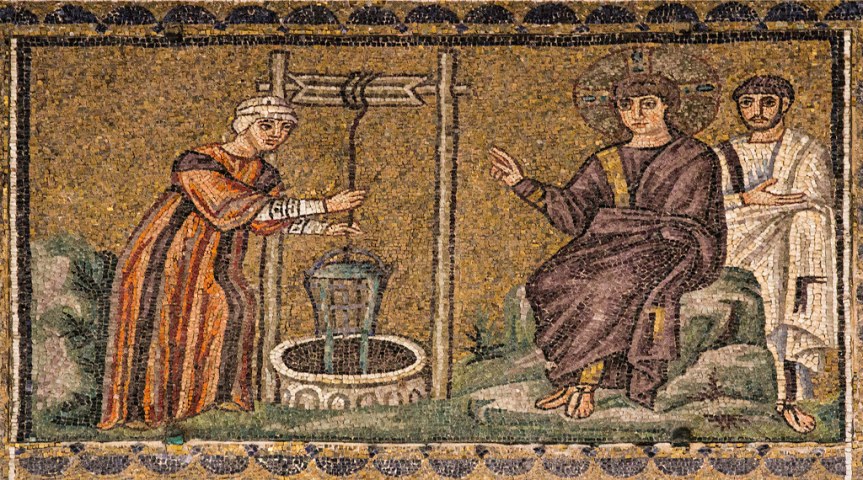
The Samaritan Woman

A Samaritan woman came to draw water, and Jesus said to her, “Give me a drink.” (His disciples had gone to the city to buy food.) The Samaritan woman said to him, “How is it that you, a Jew, ask a drink of me, a woman of Samaria?” (Jews do not share things in common with Samaritans.) Jesus answered her, “If you knew the gift of God, and who it is that is saying to you, ‘Give me a drink,’ you would have asked him, and he would have given you living water.” The woman said to him, “Sir, you have no bucket, and the well is deep. Where do you get that living water? Are you greater than our ancestor Jacob, who gave us the well, and with his sons and his flocks drank from it?” Jesus said to her, “Everyone who drinks of this water will be thirsty again, but those who drink of the water that I will give them will never be thirsty. The water that I will give will become in them a spring of water gushing up to eternal life.” The woman said to him, “Sir, give me this water, so that I may never be thirsty or have to keep coming here to draw water.”

John 4:7-15 (NRSV)

There are a lot of people who, if given the choice, we would not choose to talk to – people we might deem to be unworthy of our time or attention. It may be also that we simply wouldn’t choose to talk to them because we don’t know who they are and they don’t know us, so there is no real reason to stop and carry on a conversation. There could be many reasons why we would choose not to talk to someone, or to avoid someone if she or he tried to talk to us.

Jesus had every reason in the world not to talk to the Samaritan woman at Jacob’s well. Jesus had stopped to rest there because he was tired. The unnamed Samaritan woman approached the well to draw water. Jesus, being a Jewish rabbi, would not be expected to give a woman from Samaria the time of day let alone engage in a lengthy and meaningful conversation with her. Nevertheless, it was Jesus who instigated such a conversation with her at the well.

That conversation revolved around water. We today well know the significance of water to the Christian faith. Water is a symbol of life because it is life-giving. We need it to survive. Jesus tells this woman about a different kind of water. In the end, not only did this woman receive the living water Jesus told her about, but so did many others because of her story about the man she had never met before in her life, but who nevertheless told her everything she had ever done. This man couldn’t possibly be the Messiah, could he?

May we leave our buckets behind and receive the living water from the well that never runs dry during this season of Lent, and share that water with others.
What You’ve Heard and Seen

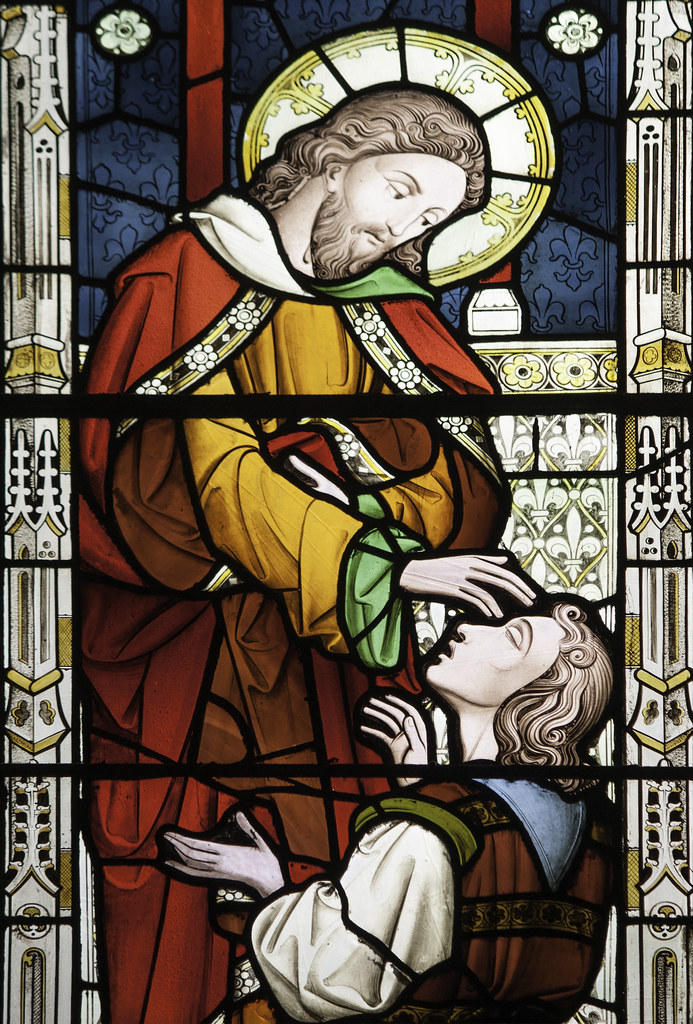
Now when John heard in prison about the things the Christ was doing, he sent word by his disciples to Jesus, asking, “Are you the one who is to come, or should we look for another?”

Jesus responded, “Go, report to John what you hear and see. Those who were blind are able to see. Those who were crippled are walking. People with skin diseases are cleansed. Those who were deaf now hear. Those who were dead are raised up. The poor have good news proclaimed to them. Happy are those who don’t stumble and fall because of me.”

When John’s disciples had gone, Jesus spoke to the crowds about John: “What did you go out to the wilderness to see? A stalk blowing in the wind? What did you go out to see? A man dressed up in refined clothes? Look, those who wear refined clothes are in royal palaces. What did you go out to see? A prophet? Yes, I tell you, and more than a prophet. He is the one of whom it is written: Look, I’m sending my messenger before you, who will prepare your way before you.

“I assure you that no one who has ever been born is greater than John the Baptist. Yet whoever is least in the kingdom of heaven is greater than he.

Matthew 11:2-11 (CEB)

So, on the Second Sunday of Advent, I preached about John the Baptist and made mention of the fact that John had no doubt in his mind about the truth of what he was preaching and no doubt about the purpose God had given him for his life. Now, on the heels of that, we have this text from Matthew where John has sent some of his disciples to ask Jesus, John’s own cousin, if he is actually the one whose coming John had been talking about before getting thrown into prison, the same Jesus whom John had himself baptized in the Jordan.

We are given the impression that John knew who Jesus was when he approached for baptism in Matthew 4 when “John tried to stop him and said, ‘I need to be baptized by you, yet you come to me?'” (v. 14). Now we read in Matthew 11 that John may not have known for sure whether or not Jesus was actually the promised Messiah. Surely some amount of time had passed between Jesus’s baptism and John’s arrest. Perhaps John’s imprisonment had cultivated some doubt in his mind about whether or not he was right about Jesus being the promised One.

Here are my thoughts on this and I would love to hear what you think: Jesus tells John’s disciples to go back and tell John about what they “hear and see” (v. 4). John baptized Jesus, but immediately after his baptism Jesus is driven by the Holy Spirit into the desert and endured temptation. After that, he would have went on about his mission, and John would not have seen him again nor would he have had occasion to witness Jesus’s work. Since John did not get to see any of Jesus’s ministry first hand, he sent his people to Jesus to find out for him. Jesus tells them, essentially, “the proof is in the pudding.” Go and tell John what they have witnessed. The blind can see. The disabled are walking. The sick are healed. The deaf hear, the dead are resurrected, and the poor (of which John was one), are offered the Good News, being put first over and above the rich elite for the first time in their lives. Jesus is doing the scandalous things that the Roman Empire and the religious leaders would be embarrassed by. If he is not the Messiah, then who else could Jesus be?

Once John heard that report, he would go on to meet his own execution knowing that he had fulfilled the purpose for his life, that he had made a pathway in the desert for God who became flesh and dwelt among us, for Emmanuel, who is God with us eternally. He would know this because people who had sought out Jesus had found him, and because Jesus had then sent them to be witnesses to John about what they had heard the Christ say and seen the Christ do.

May we go and do the same, that others may also know. O Come, O Come, Emmanuel.

New Creation

17 For I am about to create new heavens
and a new earth;
the former things shall not be remembered
or come to mind.
18 But be glad and rejoice forever
in what I am creating;
for I am about to create Jerusalem as a joy,
and its people as a delight.
19 I will rejoice in Jerusalem,
and delight in my people;
no more shall the sound of weeping be heard in it,
or the cry of distress.
20 No more shall there be in it
an infant that lives but a few days,
or an old person who does not live out a lifetime;
for one who dies at a hundred years will be considered a youth,
and one who falls short of a hundred will be considered accursed.
21 They shall build houses and inhabit them;
they shall plant vineyards and eat their fruit.
22 They shall not build and another inhabit;
they shall not plant and another eat;
for like the days of a tree shall the days of my people be,
and my chosen shall long enjoy the work of their hands.
23 They shall not labor in vain,
or bear children for calamity;
for they shall be offspring blessed by the LORD—
and their descendants as well.
24 Before they call I will answer,
while they are yet speaking I will hear.
25 The wolf and the lamb shall feed together,
the lion shall eat straw like the ox;
but the serpent—its food shall be dust!
They shall not hurt or destroy
on all my holy mountain,
says the LORD.

Isaiah 65:17-25

It might interest you to know that while writing this blog post I had a strange thing happen with my computer and I lost the entire post before I could publish it. So, let’s try this again!

We are drawing near to the beginning of the season of Advent, which is supposed to be a time of anticipation, expectation, and waiting. The question is: What exactly are we anticipating? What exactly are we expecting? What is it exactly that we are waiting for?

The first obvious answer is that we are waiting for the coming of the Messiah with great anticipation and expectation. That is the central hope of Advent. The coming Christ will save us from sin and death and afford us the great hope of resurrection and life everlasting.

The second answer which we may not always think about is what Isaiah is talking about here. The coming Messiah will not just save us from our sins, but will usher the inbreaking of the kingdom of God into the world. It marks the beginning of God initiating a new act of creation. Isaiah refers to things that people experience in life, things that bring pain and suffering, and turns them completely upside down. This is what God is doing in this new creation: Turning this broken world upside down, rebuilding what has been destroyed, and recreating in us God’s image in which we were first created. Isaiah describes what this new creation will look like and how it will operate, which is completely the opposite of what we know.

So, not only are we waiting expectantly with great anticipation for the coming Christ, but we are also waiting, expecting, and anticipating with joy the new thing God is doing.

May we seek to be a part of that new creation not only during Advent, but every day that God has given us.