

9 He also told this parable to some who trusted in themselves that they were righteous and regarded others with contempt: 10 “Two men went up to the temple to pray, one a Pharisee and the other a tax collector. 11 The Pharisee, standing by himself, was praying thus, ‘God, I thank you that I am not like other people: thieves, rogues, adulterers, or even like this tax collector. 12 I fast twice a week; I give a tenth of all my income.’ 13 But the tax collector, standing far off, would not even look up to heaven, but was beating his breast and saying, ‘God, be merciful to me, a sinner!’ 14 I tell you, this man went down to his home justified rather than the other; for all who exalt themselves will be humbled, but all who humble themselves will be exalted.”
Luke 18:9-14
It starts out almost like one of those jokes that always begins with something like, “A doctor and a lawyer walk into a bar.” This, however, is no joke. The parables that Jesus told were not necessarily about specific people and the stories he tells about them are not necessarily things that actually happened, yet these situations are the type of thing that does happen on a regular basis. In this case, we have one person understanding themselves to be somehow more righteous, more justified, more holy than another. The Pharisee in this case is making a judgment call about the tax collector and attempting to endear himself to God by comparing himself to the tax collector in a way that casts the Pharisee in a positive light.
People these days have the mistaken belief that all Pharisees were bad. That could not be further from the truth. Like most people, there were among the Pharisees some who were sadly mistaken in their beliefs, and others who were devout and faithful people. The Pharisee in this parable has the wrong idea about how God’s love works. Based on his prayer, he seems to think that there is something he can do to earn God’s favor, and he spends the prayer pointing out how he has indeed done all of those things, unlike “this tax collector.” The Pharisee doesn’t even know “this tax collector.” He has no idea what kind of person this particular tax collector is because he did not even take the time to speak with him and get to know him, judging him solely based on the fact that this man is a tax collector and represents the unsavory reputation that tax collectors of that time had in the eyes of the larger society.
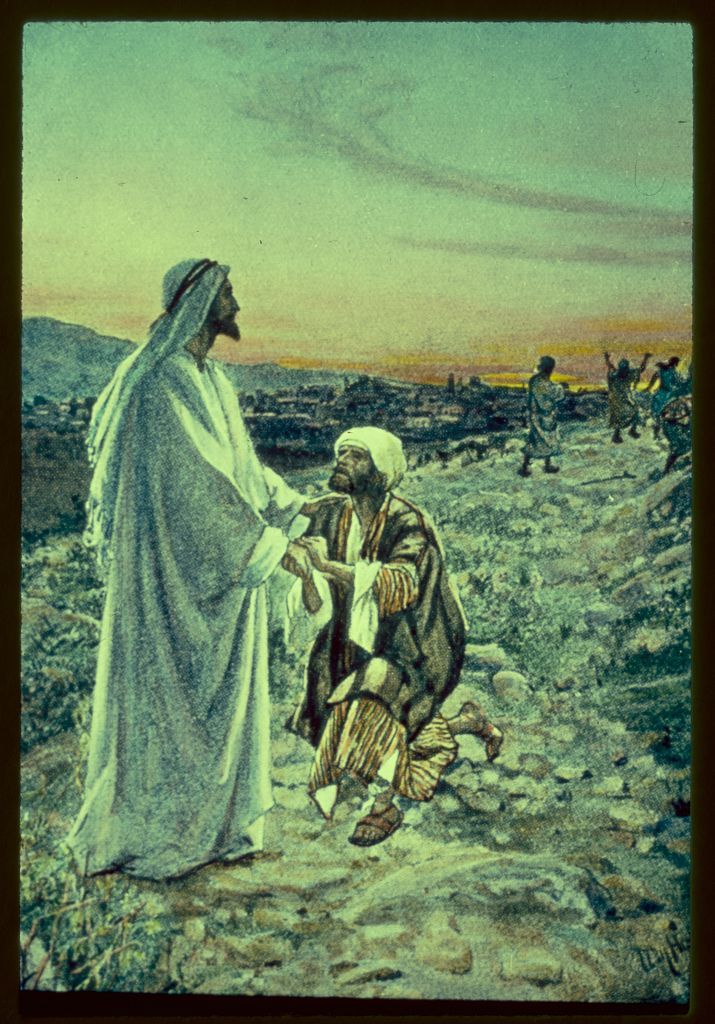
The tax collector’s prayer, on the other hand, is a study in faithfulness and contrition. The tax collector knows exactly who he is and who God is. He “beats his breast”, pounding his fist against his chest, an act of remorse and/or grief, similar to the Hebrew practice of tearing one’s clothes to express grief. He adopts a completely different posture before God, standing “far off”, bowing his head low instead of looking up to heaven. The tax collector’s prayer is not excessively self-focused because he knows that only God’s grace is able to make him whole. His prayer is much less wordy. According to the parable, he simply says, “God, be merciful to me, a sinner!”
What else needs to be said? People sometimes come to me asking, “Pastor John, how do I pray? I don’t know how.” There is no secret formula to prayer, although Jesus did give us an example in the form of the Lord’s Prayer as recorded in the gospels of Matthew and Luke:
Our Father, who art in heaven,
hallowed be thy name,
thy kingdom come,
thy will be done,
on earth as it is in heaven.
Give us this day our daily bread.
And forgive us our trespasses,
as we forgive those who trespass against us.
And lead us not into temptation,
but deliver us from evil.
For thine is the kingdom,
and the power, and the glory,
forever. Amen.
The tax collector may have only uttered one sentence, but he captured the same spirit in his prayer as we see in the Lord’s Prayer. Only God is the giver of every good and perfect gift. The real difference between this particular Pharisee and the tax collector lies not in the words they chose to use, but rather in the mindset, motivations, and depth of relationship each individual has with the God the Creator. As John Wesley once wrote, “Prayer continues in the desire of the heart.”
With all of this in mind, how is your relationship with God?
 First United Methodist Church