Inheritance

11 In Christ we have also obtained an inheritance, having been destined according to the purpose of him who accomplishes all things according to his counsel and will, 12 so that we, who were the first to set our hope on Christ, might live for the praise of his glory. 13 In him you also, when you had heard the word of truth, the gospel of your salvation, and had believed in him, were marked with the seal of the promised Holy Spirit; 14 this is the pledge of our inheritance toward redemption as God’s own people, to the praise of his glory. 15 I have heard of your faith in the Lord Jesus and your love toward all the saints, and for this reason 16 I do not cease to give thanks for you as I remember you in my prayers. 17 I pray that the God of our Lord Jesus Christ, the Father of glory, may give you a spirit of wisdom and revelation as you come to know him, 18 so that, with the eyes of your heart enlightened, you may know what is the hope to which he has called you, what are the riches of his glorious inheritance among the saints, 19 and what is the immeasurable greatness of his power for us who believe, according to the working of his great power. 20 God put this power to work in Christ when he raised him from the dead and seated him at his right hand in the heavenly places, 21 far above all rule and authority and power and dominion, and above every name that is named, not only in this age but also in the age to come. 22 And he has put all things under his feet and has made him the head over all things for the church, 23 which is his body, the fullness of him who fills all in all.

Ephesians 1:11-23 (NRSV)

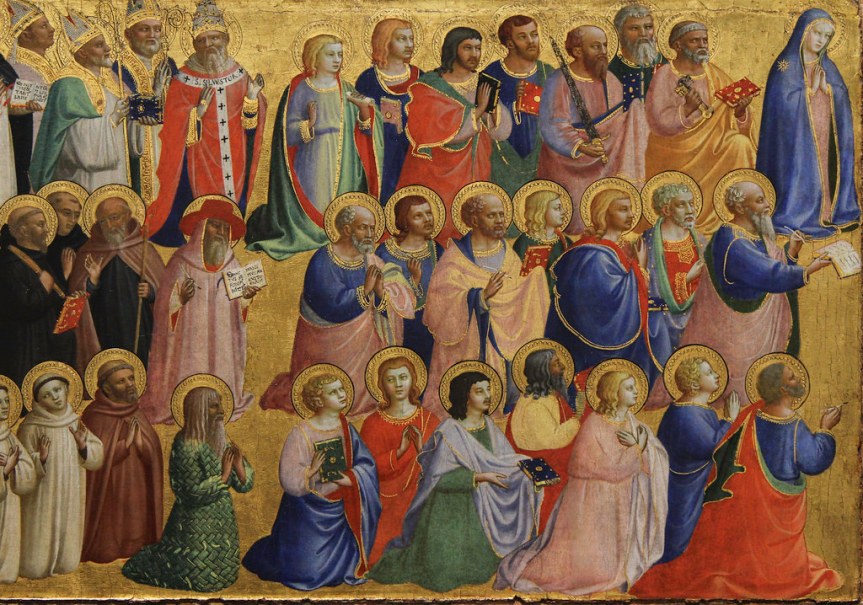
Today is All Saints’ Day. In the Church we remember all the saints, especially those who have died and gone on to become part of that “great cloud of witnesses” (Hebrews 11 and 12) by whom we are surrounded and who have fought the good fight, finished the race, and kept the faith.

As we look around at the empty pews in our church, we sometimes can still see those saints who once sat in them. We think of all they did to serve God through the church. We remember their faces and their voices. They may not be with us in a physical sense anymore, but we remember them and they are still with us in a very real sense. We are reminded by this week’s text from Paul’s letter to the church at Ephesus that Christ has set up an inheritance for us. These saints we remember this week have received the fullness of that promised inheritance and now serve in the throne room of God in everlasting peace and life.

May we be inspired to serve as they did here in this time and place, that we may one day be reunited with them as we, too, receive the fullness of the inheritance of Christ the Lord, and join that great cloud of witnesses to sing once again with the saints of light.


A Pharisee and a Tax Collector Walk Into The Temple…

9 He also told this parable to some who trusted in themselves that they were righteous and regarded others with contempt: 10 “Two men went up to the temple to pray, one a Pharisee and the other a tax collector. 11 The Pharisee, standing by himself, was praying thus, ‘God, I thank you that I am not like other people: thieves, rogues, adulterers, or even like this tax collector. 12 I fast twice a week; I give a tenth of all my income.’ 13 But the tax collector, standing far off, would not even look up to heaven, but was beating his breast and saying, ‘God, be merciful to me, a sinner!’ 14 I tell you, this man went down to his home justified rather than the other; for all who exalt themselves will be humbled, but all who humble themselves will be exalted.”

Luke 18:9-14

It starts out almost like one of those jokes that always begins with something like, “A doctor and a lawyer walk into a bar.” This, however, is no joke. The parables that Jesus told were not necessarily about specific people and the stories he tells about them are not necessarily things that actually happened, yet these situations are the type of thing that does happen on a regular basis. In this case, we have one person understanding themselves to be somehow more righteous, more justified, more holy than another. The Pharisee in this case is making a judgment call about the tax collector and attempting to endear himself to God by comparing himself to the tax collector in a way that casts the Pharisee in a positive light.

People these days have the mistaken belief that all Pharisees were bad. That could not be further from the truth. Like most people, there were among the Pharisees some who were sadly mistaken in their beliefs, and others who were devout and faithful people. The Pharisee in this parable has the wrong idea about how God’s love works. Based on his prayer, he seems to think that there is something he can do to earn God’s favor, and he spends the prayer pointing out how he has indeed done all of those things, unlike “this tax collector.” The Pharisee doesn’t even know “this tax collector.” He has no idea what kind of person this particular tax collector is because he did not even take the time to speak with him and get to know him, judging him solely based on the fact that this man is a tax collector and represents the unsavory reputation that tax collectors of that time had in the eyes of the larger society.

The tax collector’s prayer, on the other hand, is a study in faithfulness and contrition. The tax collector knows exactly who he is and who God is. He “beats his breast”, pounding his fist against his chest, an act of remorse and/or grief, similar to the Hebrew practice of tearing one’s clothes to express grief. He adopts a completely different posture before God, standing “far off”, bowing his head low instead of looking up to heaven. The tax collector’s prayer is not excessively self-focused because he knows that only God’s grace is able to make him whole. His prayer is much less wordy. According to the parable, he simply says, “God, be merciful to me, a sinner!”

What else needs to be said? People sometimes come to me asking, “Pastor John, how do I pray? I don’t know how.” There is no secret formula to prayer, although Jesus did give us an example in the form of the Lord’s Prayer as recorded in the gospels of Matthew and Luke:

Our Father, who art in heaven,
hallowed be thy name,
thy kingdom come,
thy will be done,
on earth as it is in heaven.
Give us this day our daily bread.
And forgive us our trespasses,
as we forgive those who trespass against us.
And lead us not into temptation,
but deliver us from evil.
For thine is the kingdom,
and the power, and the glory,
forever. Amen.

The tax collector may have only uttered one sentence, but he captured the same spirit in his prayer as we see in the Lord’s Prayer. Only God is the giver of every good and perfect gift. The real difference between this particular Pharisee and the tax collector lies not in the words they chose to use, but rather in the mindset, motivations, and depth of relationship each individual has with the God the Creator. As John Wesley once wrote, “Prayer continues in the desire of the heart.”

With all of this in mind, how is your relationship with God?

The Human One

1 Jesus was telling them a parable about their need to pray continuously and not to be discouraged. 2 He said, “In a certain city there was a judge who neither feared God nor respected people. 3 In that city there was a widow who kept coming to him, asking, ‘Give me justice in this case against my adversary.’ 4 For a while he refused but finally said to himself, I don’t fear God or respect people, 5 but I will give this widow justice because she keeps bothering me. Otherwise, there will be no end to her coming here and embarrassing me.” 6 The Lord said, “Listen to what the unjust judge says. 7 Won’t God provide justice to his chosen people who cry out to him day and night? Will he be slow to help them? 8 I tell you, he will give them justice quickly. But when the Human One comes, will he find faithfulness on earth?”

Luke 18:1-8 (CEB)

Uh oh! There’s something in this text that may sound unfamiliar to anyone who is not familiar with the Common English (CEB) translation of scripture! We probably should take a moment to deal with that before continuing.

In most translations, the first part of verse 8 reads something like, “But when the Son of Man comes.” The “Son of Man” is a phrase used by the authors of the New Testament, writing in a highly patriarchal society, to denote and highlight the humanness of Jesus. That is, to indicate that Jesus was not only fully God, but at one and the same time also fully human. More modern translations, like the CEB here, render the Greek as “the Human One” rather than “the Son of Man” for purposes of inclusion to indicate without question that Jesus is the Messiah promised to all of God’s children.

I think that phrase the Human One also speaks to something else in this text. The reactions of the widow and the judge to each other are both very human in nature. The widow wants justice, and rightfully so. The judge wants to be left alone. The widow is convinced that she has been wronged and won’t give up until the judge does something about it. The judge is inclined not to do anything for the widow, but is annoyed by her persistence and decides to do what many people have in similar situations – give the widow what she wants simply to get her to go away. All of this is very, very human.

In the feelings we have on a daily basis due to the fact that we are human, we can often forget the truth of the nature and being of the Christ. We sometimes tend toward thinking of Christ as one with God, which is true, but we forget and are reminded that Jesus was also human, very human, fully human in fact, at the same time. As the old hymn says:

There’s not a friend like the lowly Jesus–
No, not one! no, not one!
None else could heal all our soul’s diseases–
No, not one! no, not one!

Jesus knows all about our struggles,
He will guide till the day is done;
There’s not a friend like the lowly Jesus–
No, not one! no, not one!

It is that very human and very Divine Jesus who reminds us that God will hear us when we plead our case and will give justice to us, who cry out to God day and night. How do we know this? The answer is contained in the Nicene Creed, which I will close this weeks post with. May it be a reminder of our very human faith, hope, and assurance that we are not alone in this world – that, as John Wesley said in his last words before he died, “…best of all, God is with us.”

We believe in one God,
the Father, the Almighty,
maker of heaven and earth,
of all that is, seen and unseen.

We believe in one Lord, Jesus Christ,
the only Son of God,
eternally begotten of the Father,
God from God, Light from Light,
true God from true God,
begotten, not made,
of one Being with the Father;
through him all things were made.
For us and for our salvation
     he came down from heaven,
     was incarnate of the Holy Spirit and the Virgin Mary
     and became truly human.
     For our sake he was crucified under Pontius Pilate;
     he suffered death and was buried.
     On the third day he rose again
     in accordance with the Scriptures;
     he ascended into heaven
     and is seated at the right hand of the Father.
     He will come again in glory
     to judge the living and the dead,
     and his kingdom will have no end.

We believe in the Holy Spirit, the Lord, the giver of life,
who proceeds from the Father and the Son,
who with the Father and the Son
     is worshiped and glorified,
who has spoken through the prophets.
We believe in one holy catholic* and apostolic church.
We acknowledge one baptism
     for the forgiveness of sins.
We look for the resurrection of the dead,
     and the life of the world to come. Amen.

Along the Border

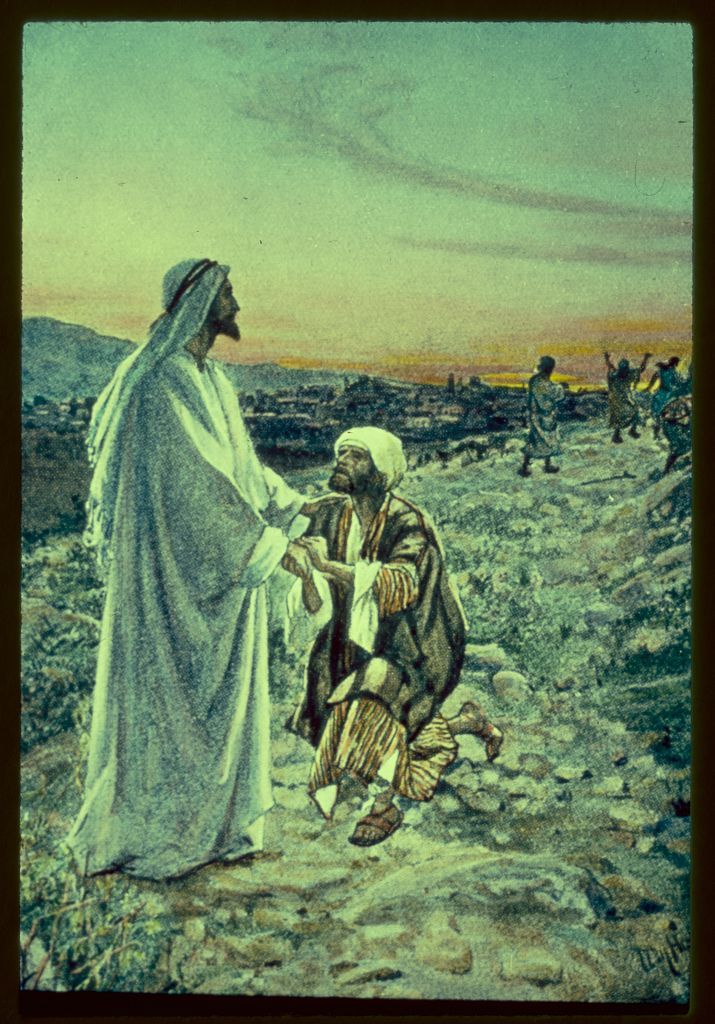
11 On the way to Jerusalem, Jesus traveled along the border between Samaria and Galilee. 12 As he entered a village, ten men with skin diseases approached him. Keeping their distance from him, 13 they raised their voices and said, “Jesus, Master, show us mercy!”
14 When Jesus saw them, he said, “Go, show yourselves to the priests.” As they left, they were cleansed. 15 One of them, when he saw that he had been healed, returned and praised God with a loud voice. 16 He fell on his face at Jesus’ feet and thanked him. He was a Samaritan. 17 Jesus replied, “Weren’t ten cleansed? Where are the other nine? 18 No one returned to praise God except this foreigner?” 19 Then Jesus said to him, “Get up and go. Your faith has healed you.”

Luke 17:11-19 (CEB)

In this text, Luke tells the story of how Jesus healed ten men of leprosy. The focus of this story is often on the fact that, out of all ten of those men, only one man came back to Jesus to give thanks for the healing and grace he received. We often consider the fact that this man was described as a “stranger” in the KJV and as a “foreigner” in more recent translations. He was a Samaritan, someone who would have been considered unclean. Luke does not tell us the ethnicity of the other nine men. It is possible that some of them were Samaritans, while others were Galileans.

All of that is interesting, but what interests me most about this text is in verse 11: “On the way to Jerusalem, Jesus traveled along the border between Samaria and Galilee.” Jesus probably could have travelled through different areas on his way to Jerusalem. Luke makes it a point to tell his readers that Jesus traveled “along the border” between these two regions, suggesting that Jesus deliberately chose this particular route over other possible routes to Jerusalem. Because Jesus chose to travel along the border, he was in a position to encounter people from both regions. Even on his way to his eventual betrayal, arrest, conviction, torture and crucifixion, Jesus chose to travel along the border, to encounter and heal along the way those whom he would soon suffer and die for. These people, who held animosity between each other for various reasons, all found healing together in the Christ.

There is a lot going on in this story, but one thing that stands out is the call upon us as disciples to travel along the border with Jesus to bring hope and healing to all who would come and receive it. The risen Christ still travels along the borders of our relationships with each other, seeking to heal our brokenness and unite us in fellowship one with another.

May we travel along the border with Jesus, in this liminal space, this in-between, and experience healing, joy, and freedom together as whole persons in Jesus Christ our Lord.

Holy Communion

26 While they were eating, Jesus took bread, blessed it, broke it, and gave it to the disciples and said, “Take and eat. This is my body.” 27 He took a cup, gave thanks, and gave it to them, saying, “Drink from this, all of you. 28 This is my blood of the covenant, which is poured out for many so that their sins may be forgiven. 29 I tell you, I won’t drink wine again until that day when I drink it in a new way with you in my Father’s kingdom.” 30 Then, after singing songs of praise, they went to the Mount of Olives.

Matthew 26:26-30 (CEB)

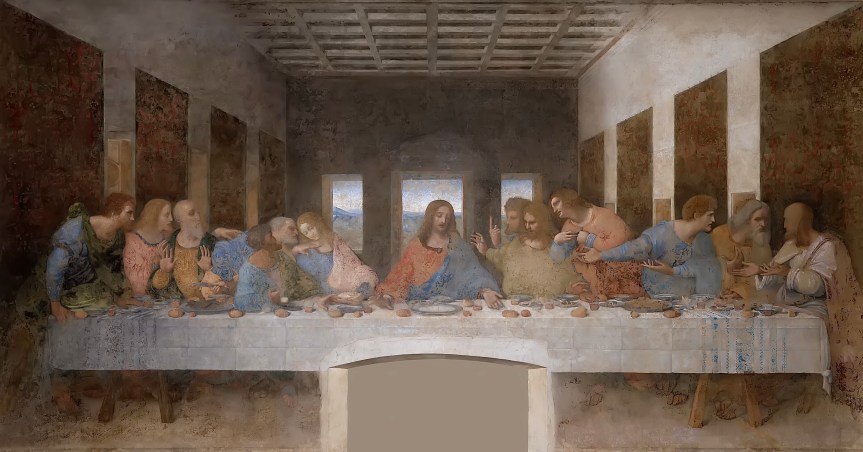
The Last Supper by Leonardo Da Vinci is one of my favorite paintings. A lot of people find hidden meanings in it. Different people have different theories about visual symbolism they say is included in the painting and what Da Vinci was trying to communicate through these things. Some of these things were highlighted and popularized in the controversial novel The Da Vinci Code by Dan Brown.

All of that aside, there is meaning to Holy Communion itself. At the traditional Passover meal depicted by Da Vinci in his masterwork, Jesus spoke words that transformed the meaning of the entire meal. When he lifted the bread, blessed and broke it, and gave it to his disciples, he proclaimed it to be his body. Then he blessed the cup, gave it to his disciples, and proclaimed it to be his blood, poured out for many for the forgiveness of their sins. Different faith traditions have attempted to explain the presence of Christ in the bread and the cup of the Sacrament. Some, like the Roman Catholic Church, believe in the doctrine of transubstantiation, which holds that the bread and the wine literally transform into the body and blood of Christ at the moment the elements are consecrated. Other traditions believe in consubstantiation, the doctrine that, essentially, the bread and the wine don’t transform into the body and blood of Christ, but that the body and the blood of Christ are literally present within them (I am oversimplifying this for the sake of brevity).

In the United Methodist Church, we understand that Christ is virtually present in the bread and the cup. The real presence of Jesus Christ is there, but we don’t know just exactly how that works. It is, therefore, a holy mystery.

Though we may not fully understand how the Sacrament of Holy Communion works, we do know this: God’s grace is mediated to us through the elements of the bread and the fruit of the vine. We come as we are to the table, the Eucharist already bought and paid for, prepared, and served, and we are invited by the Christ to come. It is more than just a memorial of the crucifixion and death of Jesus. It is a primary means of grace in Wesleyan speak. It is an essential act of worship through which God’s justifying and sanctifying grace is offered to people and can be seen at work in the human heart, an outward sign of an inward grace, imparting and imputing the righteousness of Jesus Christ to us by virtue of God’s unmerited love freely offered to all who would receive it with joy and gladness, no matter who you are, where you come from, or what you’ve done.

To this holy meal, the Lord Jesus invites you to come.

Renovation

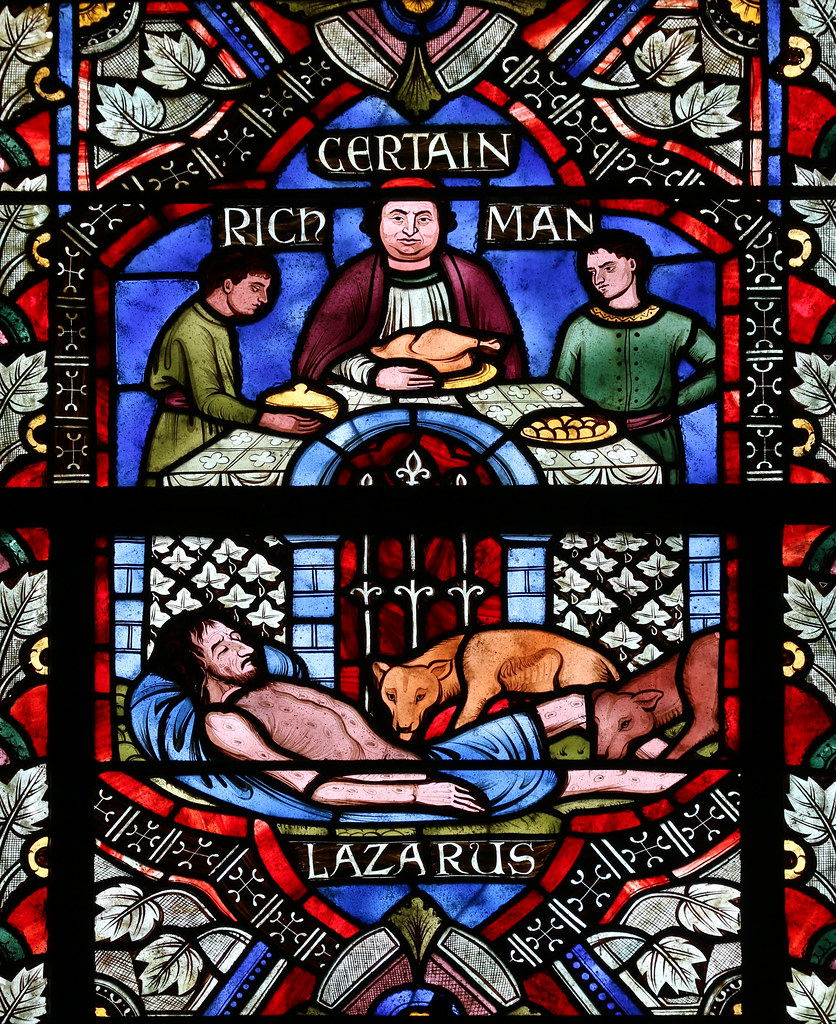
19 “There was a certain rich man who clothed himself in purple and fine linen, and who feasted luxuriously every day. 20 At his gate lay a certain poor man named Lazarus who was covered with sores. 21 Lazarus longed to eat the crumbs that fell from the rich man’s table. Instead, dogs would come and lick his sores.
22 “The poor man died and was carried by angels to Abraham’s side. The rich man also died and was buried. 23 While being tormented in the place of the dead, he looked up and saw Abraham at a distance with Lazarus at his side. 24 He shouted, ‘Father Abraham, have mercy on me. Send Lazarus to dip the tip of his finger in water and cool my tongue, because I’m suffering in this flame.’ 25 But Abraham said, ‘Child, remember that during your lifetime you received good things, whereas Lazarus received terrible things. Now Lazarus is being comforted and you are in great pain. 26 Moreover, a great crevasse has been fixed between us and you. Those who wish to cross over from here to you cannot. Neither can anyone cross from there to us.’
27 “The rich man said, ‘Then I beg you, Father, send Lazarus to my father’s house. 28 I have five brothers. He needs to warn them so that they don’t come to this place of agony.’ 29 Abraham replied, ‘They have Moses and the Prophets. They must listen to them.’ 30 The rich man said, ‘No, Father Abraham! But if someone from the dead goes to them, they will change their hearts and lives.’ 31 Abraham said, ‘If they don’t listen to Moses and the Prophets, then neither will they be persuaded if someone rises from the dead.’”

Luke 16:19-31 (CEB)

Let’s face it: Nobody wants to be Lazarus. His situation in this story is absolutely miserable. Who could imagine living their life that way every single day, day in and day out? After reading only the first part of this parable and then having to choose which of these two men a person would rather be, almost everyone would most likely choose the rich man. Perhaps it’s because we tend to focus on the reality of what is right in front of us at the time.

As I write this, I’m sitting with Angie at our house in Greenbrier watching a show about home renovation. The show follows people who buy old, dilapidated houses and renovates them while still maintaining the historical value of the homes. I’m not a home-renovation person myself. I wouldn’t even know where to start, but from watching shows like this one I understand that renovation is necessary not only to make a place livable but also to safeguard the history of the home and how it got to be there in the first place.

To cultivate a mindset in the here-and-now that allows us to see the value of being Lazarus over and above the immediate benefits of being the rich man requires a certain amount of renovation of ourselves. What is right in front of us may look very appetizing, satisfying, etc., we allow the Spirit of God to renovate our hearts and minds to see that what is now will not always be. At the same time, however, we remember where we were, where we came from in the first place. We retain the memory of who we were when we were the rich man, and we embrace the newness of life that comes with seeing the eternal value of being Lazarus.

But how does one actually choose to be Lazarus? Remember, we are speaking in allegories here. No one in their right mind would choose Lazarus’s position in this story, and that is completely understandable. Among other possibilities, I think this story invites us to consider what walls need to be torn down or revamped in the renovation of ourselves, and what changes we need to make in how we see the world and the other people in it as we allow God’s sanctifying grace to work in our hearts until that day when Christ comes in final victory and we all — rich and poor and everyone in between — feast at his heavenly banquet. Until then, we live in this liminal space where one day we feel more like the rich man and the next day we feel more like Lazarus, all the while being reminded that we are all one in Christ Jesus.

Decisive Action

1 Jesus also said to the disciples, “A certain rich man heard that his household manager was wasting his estate. 2 He called the manager in and said to him, ‘What is this I hear about you? Give me a report of your administration because you can no longer serve as my manager.’
3 “The household manager said to himself, What will I do now that my master is firing me as his manager? I’m not strong enough to dig and too proud to beg. 4 I know what I’ll do so that, when I am removed from my management position, people will welcome me into their houses.
5 “One by one, the manager sent for each person who owed his master money. He said to the first, ‘How much do you owe my master?’ 6 He said, ‘Nine hundred gallons of olive oil.’ The manager said to him, ‘Take your contract, sit down quickly, and write four hundred fifty gallons.’ 7 Then the manager said to another, ‘How much do you owe?’ He said, ‘One thousand bushels of wheat.’ He said, ‘Take your contract and write eight hundred.’
8 “The master commended the dishonest manager because he acted cleverly. People who belong to this world are more clever in dealing with their peers than are people who belong to the light. 9 I tell you, use worldly wealth to make friends for yourselves so that when it’s gone, you will be welcomed into the eternal homes.
10 “Whoever is faithful with little is also faithful with much, and the one who is dishonest with little is also dishonest with much. 11 If you haven’t been faithful with worldly wealth, who will trust you with true riches? 12 If you haven’t been faithful with someone else’s property, who will give you your own? 13 No household servant can serve two masters. Either you will hate the one and love the other, or you will be loyal to the one and have contempt for the other. You cannot serve God and wealth.”

Luke 16:1-13 (CEB)

This is one of the most confusing parables of Jesus found in the New Testament. Interpreting it accurately is a problem that the most seasoned of biblical scholars have found difficult. It’s not the kind of thing one can read a single time and come to a definitive answer about its meaning.

One thing that is clear about this story is that the household manager got himself in a fine mess and needed to come up with a solution to get himself out of it. The owner had called him into his office after learning that the manager had misused the owner’s assets and fired him. The nature of the situation was such that he could not sit back on his laurels and wait, nor could he simply ignore the problem and hope that it would just go away. He needed to take decisive action if he was going to ensure a positive outcome for his future.

In Jesus’ subsequent comments on this story about the household manager, he mentions the contrast between people who belong to this world and people who belong to the light, about how they each view and handle wealth vis-à-vis other people. Regardless of how we interpret and understand the parable itself, it is clear that Jesus is presenting the hearers with a problem that requires decisive action on their part. There is an urgent need to make a decision about how they are going to relate to God and how they are going to relate to their money in terms of which they will pledge their allegiance to.

There’s another thing to consider also: What constitutes a positive outcome for someone’s future? Does it mean money in the bank? Financial independence? Abundant resources with regard to food, clothing, shelter, etc.? If so, then the pursuit of these things will determine the nature of the decisive action we choose to take toward securing such a future. If our notion of a positive future looks like something else — an eternal home with God, the fellowship of others being added to the kingdom of God through the Church and it’s mission and ministries, then the decisive action we take will look much different.

And so, Jesus instills in us a sense of urgency with his choice of language, presenting two mutually exclusive, incompatible options with the unspoken but strongly implied challenge to make a choice, and to make the choice now: “No household servant can serve two masters. Either you will hate the one and love the other, or you will be loyal to the one and have contempt for the other. You cannot serve God and wealth” (v. 13).

Jesus leaves the decision to us. God or wealth? Other or self? Worldly homes or eternal homes?

The choice is ours.

What Is God’s Love Like?

1 All the tax collectors and sinners were gathering around Jesus to listen to him. 2 The Pharisees and legal experts were grumbling, saying, “This man welcomes sinners and eats with them.”
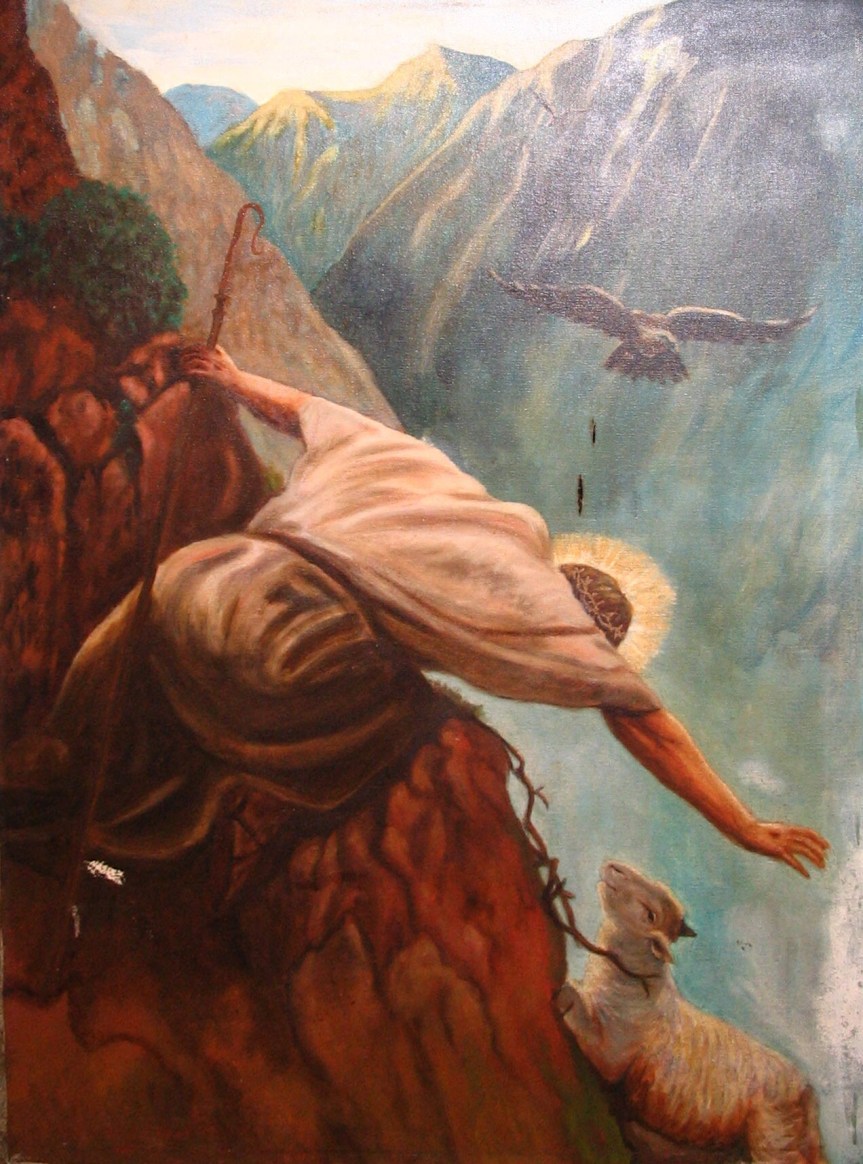
3 Jesus told them this parable: 4 “Suppose someone among you had one hundred sheep and lost one of them. Wouldn’t he leave the other ninety-nine in the pasture and search for the lost one until he finds it? 5 And when he finds it, he is thrilled and places it on his shoulders. 6 When he arrives home, he calls together his friends and neighbors, saying to them, ‘Celebrate with me because I’ve found my lost sheep.’ 7 In the same way, I tell you, there will be more joy in heaven over one sinner who changes both heart and life than over ninety-nine righteous people who have no need to change their hearts and lives.
8 “Or what woman, if she owns ten silver coins and loses one of them, won’t light a lamp and sweep the house, searching her home carefully until she finds it? 9 When she finds it, she calls together her friends and neighbors, saying, ‘Celebrate with me because I’ve found my lost coin.’ 10 In the same way, I tell you, joy breaks out in the presence of God’s angels over one sinner who changes both heart and life.”

Luke 15:1-10 (CEB)

There is a song by contemporary Christian singer-songwriter Cory Asbury that talks about the love of God. Consider the chorus:

Oh, the overwhelming, never-ending, reckless love of God.
Oh, it chases me down, fights ’till I’m found, leaves the ninety-nine.
I couldn’t earn it,
I don’t deserve it,
Still You give Yourself away.
Oh, the overwhelming, never-ending, reckless love of God.

Some have criticized that song because it refers to the love of God as “reckless”. However, Jesus’ parables in this section of Luke 15 characterize God’s love as just that. The shepherd notices one sheep out of a hundred is missing. He leaves the ninety-nine sheep and goes on a quest to find the one that was lost. Why should he care about that one? It’s only one out of a hundred. It’s not like one sheep is a huge loss. To the shepherd, however, that sheep is just as important as all the others, and when it goes missing, it is in fact more important than all the others.

When the woman loses that one coin, she tears the house apart trying to recover it. Have you ever lost something important to you and torn up the place trying to find it? I have. As a matter of fact, as I write this I have two important items that I have misplaced and have been searching everywhere I can think of to find them. So far, no luck. Does that mean I’ll just give up and stop? Absolutely not. I know they are somewhere, so I’ll keep searching for those items until I find them. That’s how important they are to me.

That shepherd and that woman were never going to stop. It didn’t matter where they had to look. They would keep looking, go wherever they needed to go, leave no stone unturned, in order to find that which was so very important to them.

That’s how God pursues us. With reckless abandon. That’s how God comes after you, because you are important to God. If you weren’t, why would God bother to become human in Jesus of Nazareth, suffer a horrible death by execution on a Roman cross of crucifixion, stay dead for three days before the Resurrection? Imagine the pain and humiliation – all in the name of finding you and bringing you back home.

Sounds pretty reckless to me, and thank God who loves us that much.

Amen.

Discipleship Ain’t Cheap

25 Large crowds were traveling with Jesus. Turning to them, he said, 26 “Whoever comes to me and doesn’t hate father and mother, spouse and children, and brothers and sisters—yes, even one’s own life—cannot be my disciple. 27 Whoever doesn’t carry their own cross and follow me cannot be my disciple.
28 “If one of you wanted to build a tower, wouldn’t you first sit down and calculate the cost, to determine whether you have enough money to complete it? 29 Otherwise, when you have laid the foundation but couldn’t finish the tower, all who see it will begin to belittle you. 30 They will say, ‘Here’s the person who began construction and couldn’t complete it!’ 31 Or what king would go to war against another king without first sitting down to consider whether his ten thousand soldiers could go up against the twenty thousand coming against him? 32 And if he didn’t think he could win, he would send a representative to discuss terms of peace while his enemy was still a long way off. 33 In the same way, none of you who are unwilling to give up all of your possessions can be my disciple.

Luke 14:25-33 (CEB)

Imagine that becoming a disciple of Jesus Christ was a service available to be purchased on an online auction site like eBay.

I know, I know. It sounds ridiculous, but just go along with me on this for a minute.

You do a search for “Jesus” and suddenly you find a listing for an auction where you can bid on an opening to become Jesus’ newest disciple. You click on the link and read the following description:

Up for auction: One spot as a disciple of Jesus of Nazareth who is called CHRIST, the one and only Savior of humankind, the Holy Son of God, the Divine Word made flesh, crucified, dead and buried and resurrected on the third day. DON’T WAIT UNTIL IT’S TOO LATE!!! Secure your eternal future NOW while Jesus is still seated at the right hand of God, BEFORE he comes back to judge the living and the dead! ALL SALES ARE FINAL!!! THIS SELLER DOES NOT ACCEPT RETURNS. PLEASE READ THE AUCTION LISTING CAREFULLY BEFORE BIDDING. PAYMENT REQUIRED IMMEDIATELY! GOOD LUCK AND HAPPY BIDDING!!

Sounds good, right? Then you go to click the button to enter your bid, but you stop because you see the following:

Starting Bid: Everything You Have

You think to yourself, “That’s a high price to pay!” You begin to consider the cost. Maybe you decide to sleep on it and make a decision tomorrow. Surely no one will bid ahead of you and win the auction overnight.

When you click that “Bid” button or “Buy It Now” and you click “Submit” on a site like eBay, you are entering into an agreement to purchase the item listed for that amount should you win the auction, or for that price if it is a “Buy It Now” listing. In other words, you are making a commitment.

Discipleship is a commitment. Jesus does not ask that we give away all of our money, or that we give away all of our possessions, or that we sell all of our possessions and then give away the proceeds. Nor is Jesus actually commanding us to hate our families. The point that Jesus is making is that, in order to be one of his disciples, Jesus must be the single most important thing in your life. Our discipleship takes precedence over everything else. That does not mean that we are to neglect our families or live in poverty. Quite the opposite, in fact. However, it does mean that when anything else conflicts with our discipleship, we are called to choose our covenant relationship with Jesus over and above that other thing.

This Sunday, we will gather together once again at the table of Holy Communion. It is an outward sign of an inward grace, a sign of the covenant God has made with us through Jesus Christ. We come to the table having made a decision to enter into and honor that covenant as disciples.

Whoever you are, you have a place at that table. I hope to see you there.

The Most Important Place

1 One Sabbath, when Jesus went to share a meal in the home of one of the leaders of the Pharisees, they were watching him closely.

7 When Jesus noticed how the guests sought out the best seats at the table, he told them a parable. 8 “When someone invites you to a wedding celebration, don’t take your seat in the place of honor. Someone more highly regarded than you could have been invited by your host. 9 The host who invited both of you will come and say to you, ‘Give your seat to this other person.’ Embarrassed, you will take your seat in the least important place. 10 Instead, when you receive an invitation, go and sit in the least important place. When your host approaches you, he will say, ‘Friend, move up here to a better seat.’ Then you will be honored in the presence of all your fellow guests. 11 All who lift themselves up will be brought low, and those who make themselves low will be lifted up.”
12 Then Jesus said to the person who had invited him, “When you host a lunch or dinner, don’t invite your friends, your brothers and sisters, your relatives, or rich neighbors. If you do, they will invite you in return and that will be your reward. 13 Instead, when you give a banquet, invite the poor, crippled, lame, and blind. 14 And you will be blessed because they can’t repay you. Instead, you will be repaid when the just are resurrected.”

Luke 14:7-14 (CEB)

I don’t know about you, but some people fight their toughest battles on a daily basis in the most unlikely of places: the grocery store parking lot.

I’ve witnessed it first-hand. People will drive around the lot, sneaking around corners, cutting through empty parking spaces instead of driving along the proper lanes, cut in front of people, sit in their cars and wait in the middle of the driving lane for another car to pull out, holding up other drivers in the process, and a host of other behaviors in the name of getting the best parking space.

I try not to do that. Sometimes I want to get a closer parking space for some specific reason, but generally I try to park and walk recognizing that there are other people who need the closer space more than I do. I must confess, however, that I have on occasion engaged in some of the aforementioned parking lot maneuvers in an effort to secure a more desirable parking space for myself.

The question is: Why? The Luke 14 text this week begs the question. What is it about the “place of honor” that is so attractive to us? Is it out-and-out wrong to desire to be the one in the most honorable position available?

Maybe it’s not so much a question of right versus wrong as it is a question of what one’s priority is. What is one’s ultimate goal, really? In this parable, Jesus strongly suggests that our ultimate goal should not be to sit in that one highly coveted seat, but that if we do the opposite, then we might get to sit in the seat of honor after all. He goes on to add some instruction about inviting people, the crux of which is to invite people who can’t offer you anything in return. What in the world is Jesus talking about, anyway?

The answer, at least for our purposes, can be found in what Jesus says in verse 11, “All who lift themselves up will be brought low, and those who make themselves low will be lifted up” (Luke 14:11, emphasis mine). Notice that whatever the person is trying to do themselves, the opposite will be done to them by someone else. The people of first-century Judea were living under the captive rule of the highly corrupt Roman empire, an organization that was accustomed to taking what they want by one form of attrition or another. Jesus came teaching and preaching a radically different way of being in the world, starting with the famed Sermon on the Mount, in which Jesus basically preached against the tyranny of Rome by telling people that the kingdom of God was completely different – that is, completely opposite – of what they were hearing from their captors. The reality of the world was not what it appeared to be: Taking care of oneself did not mean neglecting the other. Bettering oneself did not equate to trampling on someone else. The, “I’ll scratch your back if you’ll scratch mine,” mentality was not the way people were meant to live because it emphasizes self-preservation and self-advancement as the priority to the exclusion of everything – and everyone – else.

Not so, says Jesus. To sit in the seat of honor is not ours to take for ourselves. It is the good gift of God that has already been given to us when we feed the hungry, heal the sick, clothe the naked, and welcome the sinner. It is a seat of honor that does not match the description of it that we have always heard. Instead, it is a place of honor that can only be found in answering the invitation of Christ the Resurrected Lord to follow him into the world and walk alongside people that no one else wants to be associated with. We do not choose to sit in the seat of honor. We are invited to sit in a place that, should we accept the invitation do so, will change our perspective, allow us to see others less from a self point of view and more from a God point of view, and transform our hearts and minds…and our priorities.