
Inheritance

11 In Christ we have also obtained an inheritance, having been destined according to the purpose of him who accomplishes all things according to his counsel and will, 12 so that we, who were the first to set our hope on Christ, might live for the praise of his glory. 13 In him you also, when you had heard the word of truth, the gospel of your salvation, and had believed in him, were marked with the seal of the promised Holy Spirit; 14 this is the pledge of our inheritance toward redemption as God’s own people, to the praise of his glory. 15 I have heard of your faith in the Lord Jesus and your love toward all the saints, and for this reason 16 I do not cease to give thanks for you as I remember you in my prayers. 17 I pray that the God of our Lord Jesus Christ, the Father of glory, may give you a spirit of wisdom and revelation as you come to know him, 18 so that, with the eyes of your heart enlightened, you may know what is the hope to which he has called you, what are the riches of his glorious inheritance among the saints, 19 and what is the immeasurable greatness of his power for us who believe, according to the working of his great power. 20 God put this power to work in Christ when he raised him from the dead and seated him at his right hand in the heavenly places, 21 far above all rule and authority and power and dominion, and above every name that is named, not only in this age but also in the age to come. 22 And he has put all things under his feet and has made him the head over all things for the church, 23 which is his body, the fullness of him who fills all in all.

Ephesians 1:11-23 (NRSV)

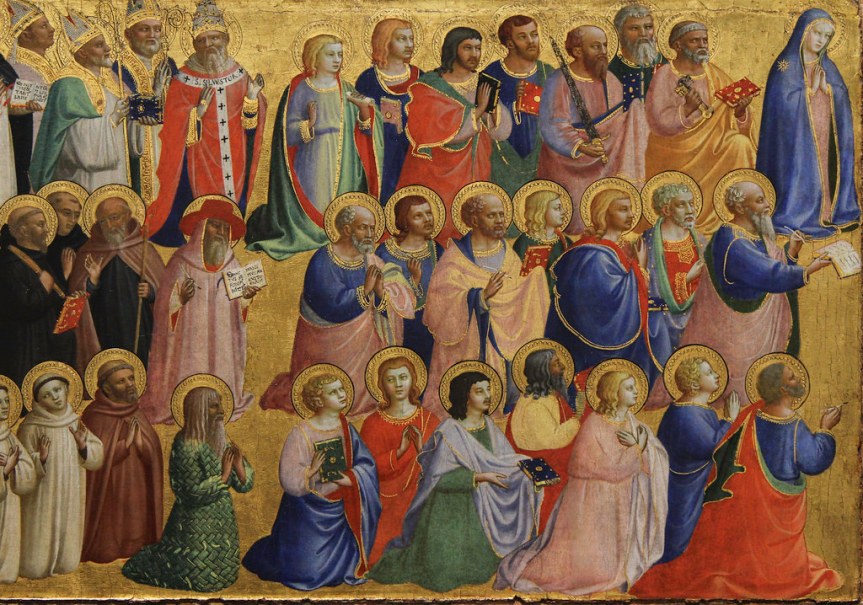
Today is All Saints’ Day. In the Church we remember all the saints, especially those who have died and gone on to become part of that “great cloud of witnesses” (Hebrews 11 and 12) by whom we are surrounded and who have fought the good fight, finished the race, and kept the faith.

As we look around at the empty pews in our church, we sometimes can still see those saints who once sat in them. We think of all they did to serve God through the church. We remember their faces and their voices. They may not be with us in a physical sense anymore, but we remember them and they are still with us in a very real sense. We are reminded by this week’s text from Paul’s letter to the church at Ephesus that Christ has set up an inheritance for us. These saints we remember this week have received the fullness of that promised inheritance and now serve in the throne room of God in everlasting peace and life.

May we be inspired to serve as they did here in this time and place, that we may one day be reunited with them as we, too, receive the fullness of the inheritance of Christ the Lord, and join that great cloud of witnesses to sing once again with the saints of light.

Holy Communion

26 While they were eating, Jesus took bread, blessed it, broke it, and gave it to the disciples and said, “Take and eat. This is my body.” 27 He took a cup, gave thanks, and gave it to them, saying, “Drink from this, all of you. 28 This is my blood of the covenant, which is poured out for many so that their sins may be forgiven. 29 I tell you, I won’t drink wine again until that day when I drink it in a new way with you in my Father’s kingdom.” 30 Then, after singing songs of praise, they went to the Mount of Olives.

Matthew 26:26-30 (CEB)

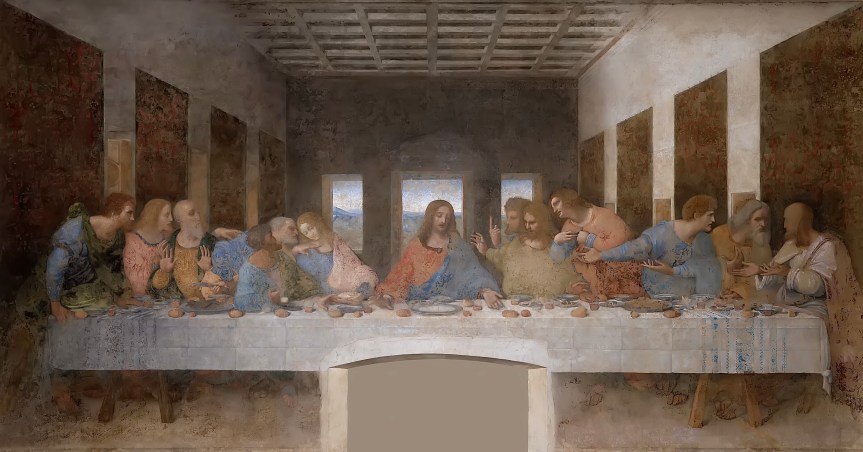
The Last Supper by Leonardo Da Vinci is one of my favorite paintings. A lot of people find hidden meanings in it. Different people have different theories about visual symbolism they say is included in the painting and what Da Vinci was trying to communicate through these things. Some of these things were highlighted and popularized in the controversial novel The Da Vinci Code by Dan Brown.

All of that aside, there is meaning to Holy Communion itself. At the traditional Passover meal depicted by Da Vinci in his masterwork, Jesus spoke words that transformed the meaning of the entire meal. When he lifted the bread, blessed and broke it, and gave it to his disciples, he proclaimed it to be his body. Then he blessed the cup, gave it to his disciples, and proclaimed it to be his blood, poured out for many for the forgiveness of their sins. Different faith traditions have attempted to explain the presence of Christ in the bread and the cup of the Sacrament. Some, like the Roman Catholic Church, believe in the doctrine of transubstantiation, which holds that the bread and the wine literally transform into the body and blood of Christ at the moment the elements are consecrated. Other traditions believe in consubstantiation, the doctrine that, essentially, the bread and the wine don’t transform into the body and blood of Christ, but that the body and the blood of Christ are literally present within them (I am oversimplifying this for the sake of brevity).

In the United Methodist Church, we understand that Christ is virtually present in the bread and the cup. The real presence of Jesus Christ is there, but we don’t know just exactly how that works. It is, therefore, a holy mystery.

Though we may not fully understand how the Sacrament of Holy Communion works, we do know this: God’s grace is mediated to us through the elements of the bread and the fruit of the vine. We come as we are to the table, the Eucharist already bought and paid for, prepared, and served, and we are invited by the Christ to come. It is more than just a memorial of the crucifixion and death of Jesus. It is a primary means of grace in Wesleyan speak. It is an essential act of worship through which God’s justifying and sanctifying grace is offered to people and can be seen at work in the human heart, an outward sign of an inward grace, imparting and imputing the righteousness of Jesus Christ to us by virtue of God’s unmerited love freely offered to all who would receive it with joy and gladness, no matter who you are, where you come from, or what you’ve done.

To this holy meal, the Lord Jesus invites you to come.

Jesus Saves, Jesus Saves

10 Jesus was teaching in one of the synagogues on the Sabbath. 11 A woman was there who had been disabled by a spirit for eighteen years. She was bent over and couldn’t stand up straight. 12 When he saw her, Jesus called her to him and said, “Woman, you are set free from your sickness.” 13 He placed his hands on her and she straightened up at once and praised God.
14 The synagogue leader, incensed that Jesus had healed on the Sabbath, responded, “There are six days during which work is permitted. Come and be healed on those days, not on the Sabbath day.”
15 The Lord replied, “Hypocrites! Don’t each of you on the Sabbath untie your ox or donkey from its stall and lead it out to get a drink? 16 Then isn’t it necessary that this woman, a daughter of Abraham, bound by Satan for eighteen long years, be set free from her bondage on the Sabbath day?” 17 When he said these things, all his opponents were put to shame, but all those in the crowd rejoiced at all the extraordinary things he was doing.

Luke 13:10-17 (CEB)

We often like to wait for the right time to do things. Maybe you’ve had someone ask you, “When are you going to do this or that?” and you answered, “I’m waiting for the right time.” Often this happens with regard to delivering some kind of news to someone that may or may not be a good thing. When a couple finds out they are having a new baby, they often wait for the right time to let everyone know the good news.

In this text, Luke reminds us that Jesus does not wait until the time is right. The woman was in the synagogue at that very moment, on that very day, and it didn’t matter to Jesus that it happened to be the Sabbath. This unnamed woman needed healing and Jesus healed her immediately, without hesitation. He didn’t pause to wonder whether it was the right time or not. He didn’t consider whether or not he should heal her since it would mean doing work on the Sabbath. He wasn’t afraid of what the synagogue leader might think if he healed her on the Sabbath. Jesus saw this woman’s need for healing and healed her. It reminds me of the old hymn “Jesus Saves”, especially the third verse:

Sing above the battle strife:
Jesus saves! Jesus saves!
By His death and endless life:
Jesus saves! Jesus saves!
Sing it softly through the gloom,
When the heart for mercy craves;
Sing in triumph o’er the tomb:
Jesus saves! Jesus saves!

https://hymnary.org/text/we_have_heard_the_joyful_sound

While the battle is still raging in our hearts and minds, Jesus does not wait. Jesus saves.

When we feel trapped in the gloom and darkness, Jesus does not wait. Jesus saves.

While our hearts are still crying out for mercy, Jesus does not wait. Jesus saves.

We can, right this very minute, stand in triumph at the mouth of the empty tomb of the resurrection and boldly proclaim, “Jesus saves, Jesus saves!” because right now is the right time.

Jesus doesn’t wait. Neither should we, because there is someone out there right now who needs healing, and Christ has no hands nor feet in this world but ours. Let us go and, through our service as disciples of Jesus Christ, proclaim to the lost, the hurting, the sick, the grieving, the hungry, the thirsty, the lonely, the broken hearted, “Jesus saves! Jesus saves!”