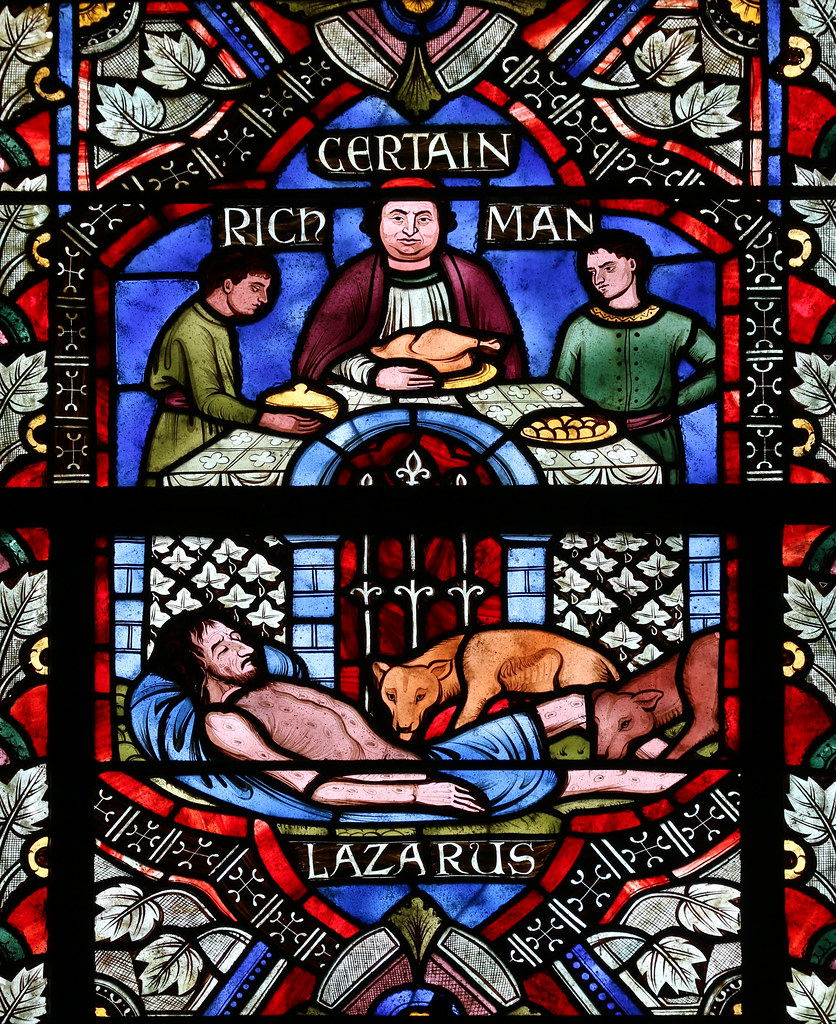
19 “There was a certain rich man who clothed himself in purple and fine linen, and who feasted luxuriously every day. 20 At his gate lay a certain poor man named Lazarus who was covered with sores. 21 Lazarus longed to eat the crumbs that fell from the rich man’s table. Instead, dogs would come and lick his sores.
22 “The poor man died and was carried by angels to Abraham’s side. The rich man also died and was buried. 23 While being tormented in the place of the dead, he looked up and saw Abraham at a distance with Lazarus at his side. 24 He shouted, ‘Father Abraham, have mercy on me. Send Lazarus to dip the tip of his finger in water and cool my tongue, because I’m suffering in this flame.’ 25 But Abraham said, ‘Child, remember that during your lifetime you received good things, whereas Lazarus received terrible things. Now Lazarus is being comforted and you are in great pain. 26 Moreover, a great crevasse has been fixed between us and you. Those who wish to cross over from here to you cannot. Neither can anyone cross from there to us.’
27 “The rich man said, ‘Then I beg you, Father, send Lazarus to my father’s house. 28 I have five brothers. He needs to warn them so that they don’t come to this place of agony.’ 29 Abraham replied, ‘They have Moses and the Prophets. They must listen to them.’ 30 The rich man said, ‘No, Father Abraham! But if someone from the dead goes to them, they will change their hearts and lives.’ 31 Abraham said, ‘If they don’t listen to Moses and the Prophets, then neither will they be persuaded if someone rises from the dead.’”
Luke 16:19-31 (CEB)
Let’s face it: Nobody wants to be Lazarus. His situation in this story is absolutely miserable. Who could imagine living their life that way every single day, day in and day out? After reading only the first part of this parable and then having to choose which of these two men a person would rather be, almost everyone would most likely choose the rich man. Perhaps it’s because we tend to focus on the reality of what is right in front of us at the time.
As I write this, I’m sitting with Angie at our house in Greenbrier watching a show about home renovation. The show follows people who buy old, dilapidated houses and renovates them while still maintaining the historical value of the homes. I’m not a home-renovation person myself. I wouldn’t even know where to start, but from watching shows like this one I understand that renovation is necessary not only to make a place livable but also to safeguard the history of the home and how it got to be there in the first place.
To cultivate a mindset in the here-and-now that allows us to see the value of being Lazarus over and above the immediate benefits of being the rich man requires a certain amount of renovation of ourselves. What is right in front of us may look very appetizing, satisfying, etc., we allow the Spirit of God to renovate our hearts and minds to see that what is now will not always be. At the same time, however, we remember where we were, where we came from in the first place. We retain the memory of who we were when we were the rich man, and we embrace the newness of life that comes with seeing the eternal value of being Lazarus.
But how does one actually choose to be Lazarus? Remember, we are speaking in allegories here. No one in their right mind would choose Lazarus’s position in this story, and that is completely understandable. Among other possibilities, I think this story invites us to consider what walls need to be torn down or revamped in the renovation of ourselves, and what changes we need to make in how we see the world and the other people in it as we allow God’s sanctifying grace to work in our hearts until that day when Christ comes in final victory and we all — rich and poor and everyone in between — feast at his heavenly banquet. Until then, we live in this liminal space where one day we feel more like the rich man and the next day we feel more like Lazarus, all the while being reminded that we are all one in Christ Jesus.

 First United Methodist Church