
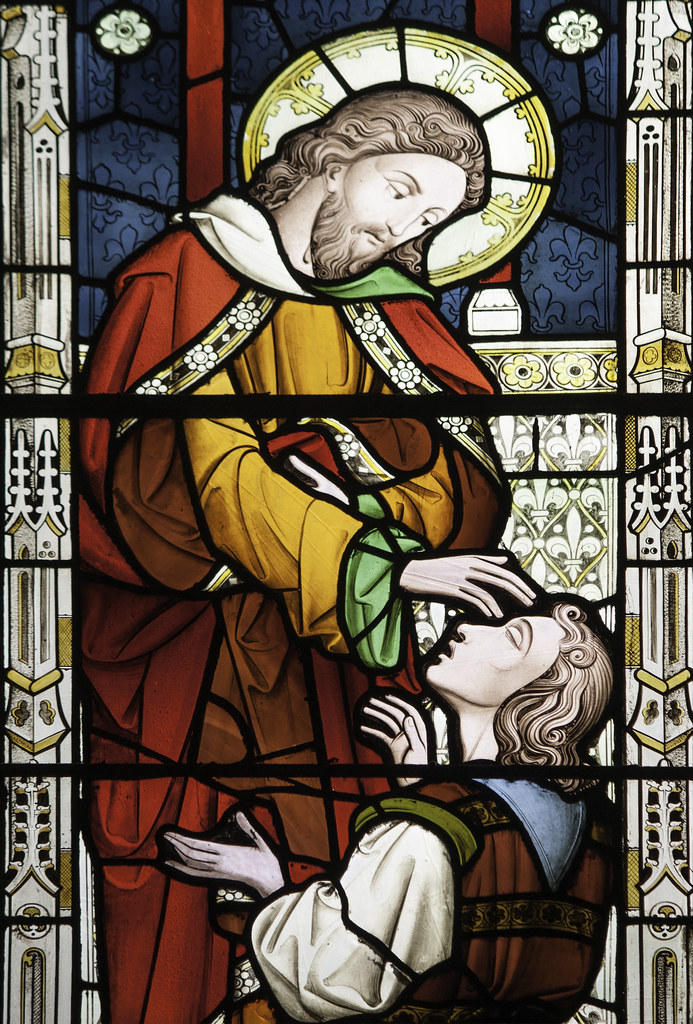
What You’ve Heard and Seen

Now when John heard in prison about the things the Christ was doing, he sent word by his disciples to Jesus, asking, “Are you the one who is to come, or should we look for another?”

Jesus responded, “Go, report to John what you hear and see. Those who were blind are able to see. Those who were crippled are walking. People with skin diseases are cleansed. Those who were deaf now hear. Those who were dead are raised up. The poor have good news proclaimed to them. Happy are those who don’t stumble and fall because of me.”

When John’s disciples had gone, Jesus spoke to the crowds about John: “What did you go out to the wilderness to see? A stalk blowing in the wind? What did you go out to see? A man dressed up in refined clothes? Look, those who wear refined clothes are in royal palaces. What did you go out to see? A prophet? Yes, I tell you, and more than a prophet. He is the one of whom it is written: Look, I’m sending my messenger before you, who will prepare your way before you.

“I assure you that no one who has ever been born is greater than John the Baptist. Yet whoever is least in the kingdom of heaven is greater than he.

Matthew 11:2-11 (CEB)

So, on the Second Sunday of Advent, I preached about John the Baptist and made mention of the fact that John had no doubt in his mind about the truth of what he was preaching and no doubt about the purpose God had given him for his life. Now, on the heels of that, we have this text from Matthew where John has sent some of his disciples to ask Jesus, John’s own cousin, if he is actually the one whose coming John had been talking about before getting thrown into prison, the same Jesus whom John had himself baptized in the Jordan.

We are given the impression that John knew who Jesus was when he approached for baptism in Matthew 4 when “John tried to stop him and said, ‘I need to be baptized by you, yet you come to me?'” (v. 14). Now we read in Matthew 11 that John may not have known for sure whether or not Jesus was actually the promised Messiah. Surely some amount of time had passed between Jesus’s baptism and John’s arrest. Perhaps John’s imprisonment had cultivated some doubt in his mind about whether or not he was right about Jesus being the promised One.

Here are my thoughts on this and I would love to hear what you think: Jesus tells John’s disciples to go back and tell John about what they “hear and see” (v. 4). John baptized Jesus, but immediately after his baptism Jesus is driven by the Holy Spirit into the desert and endured temptation. After that, he would have went on about his mission, and John would not have seen him again nor would he have had occasion to witness Jesus’s work. Since John did not get to see any of Jesus’s ministry first hand, he sent his people to Jesus to find out for him. Jesus tells them, essentially, “the proof is in the pudding.” Go and tell John what they have witnessed. The blind can see. The disabled are walking. The sick are healed. The deaf hear, the dead are resurrected, and the poor (of which John was one), are offered the Good News, being put first over and above the rich elite for the first time in their lives. Jesus is doing the scandalous things that the Roman Empire and the religious leaders would be embarrassed by. If he is not the Messiah, then who else could Jesus be?

Once John heard that report, he would go on to meet his own execution knowing that he had fulfilled the purpose for his life, that he had made a pathway in the desert for God who became flesh and dwelt among us, for Emmanuel, who is God with us eternally. He would know this because people who had sought out Jesus had found him, and because Jesus had then sent them to be witnesses to John about what they had heard the Christ say and seen the Christ do.

May we go and do the same, that others may also know. O Come, O Come, Emmanuel.

Sticking Out Like A Sore Thumb

In those days, John the Baptist appeared in the wilderness of Judea, proclaiming, “Repent, for the kingdom of heaven has come near.”

This is the one of whom the prophet Isaiah spoke when he said, “The voice of one crying out in the wilderness: ‘Prepare the way of the Lord, make his paths straight.'”

Now John wore clothing of camel’s hair with a leather belt around his waist, and his food was locusts and wild honey. Then the people of Jerusalem and all Judea were going out to him, and all the region along the Jordan, and they were baptized by him in the river Jordan, confessing their sins.

But when he saw many Pharisees and Sadducees coming for baptism, he said to them, “You brood of vipers! Who warned you to flee from the wrath to come? Bear fruit worthy of repentance. Do not presume to say to yourselves, ‘We have Abraham as our ancestor’; for I tell you, God is able from these stones to raise up children to Abraham. Even now the ax is lying at the root of the trees; every tree therefore that does not bear good fruit is cut down and thrown into the fire.

“I baptize you with water for repentance, but one who is more powerful than I is coming after me; I am not worthy to carry his sandals. He will baptize you with the Holy Spirit and fire.”

Matthew 3:1-11 (NRSV)

This is the first blog update in a few weeks because of my inability to login and access the website. Thankfully, we have that fixed and now I can get back to regular weekly updates.

By the standards of people in first century Judea, John the Baptist was a weirdo. He stuck out like a sore thumb. I don’t know the exact origins of the idiom “stick out like a sore thumb,” but it usually is used to describe something that is clearly out of place and does not match its surroundings. John the Baptist certainly fit that description. He did not seem concerned with making himself look like other people. He did not seem concerned with acting like other people. Instead, he was focused on his mission to “prepare the way of the Lord.”

When the Pharisees and Sadducees showed up, he did not cut them any slack. He called them a “brood of vipers” (think “den of snakes”) and proceeded to tell them how the cow ate the cabbage, so to speak. John the Baptist doesn’t sound like the shining example of how to win friends and influence people, yet people from all over the countryside were coming to him for baptism in the Jordan.

What was his secret? Well, he was following God’s calling on his life for one thing. Another thing is that he was singularly focused on his mission. One of the most important things about John the Baptist though is that he was not afraid to just be himself.

He wasn’t weird just because of what he wore as clothing or what he ate as food. John was weird because, in a world of so many people who were so concerned with keeping up appearances, John just went along being his authentic self.

How often do we just allow ourselves to be our authentic selves? What kind of pressures do we face in life to present ourselves in a certain way? Who has God created us to be and how are we reflecting that to the world?

There is an old movie from the 80’s called “The Breakfast Club.” I’m sure you’ve seen it. Some teenagers get stuck in detention together after school and the whole movie is about how they relate to each other and the trouble they get themselves, and each other, into before they are allowed to leave. Each character is unique, and each one presents to the other as her or his authentic self. Through doing so they gain new understandings of each other and are changed in ways that make them better people. When John the Baptist preached repentance, from the Greek word metanoia meaning “change of heart and life”, what if he was telling the people, at least in part, to stop pretending and just be who God created them to be? That’s what John was doing. That’s what Jesus did.

Let us go with the confidence of children of God and do the same. Amen.