Holy Communion

26 While they were eating, Jesus took bread, blessed it, broke it, and gave it to the disciples and said, “Take and eat. This is my body.” 27 He took a cup, gave thanks, and gave it to them, saying, “Drink from this, all of you. 28 This is my blood of the covenant, which is poured out for many so that their sins may be forgiven. 29 I tell you, I won’t drink wine again until that day when I drink it in a new way with you in my Father’s kingdom.” 30 Then, after singing songs of praise, they went to the Mount of Olives.

Matthew 26:26-30 (CEB)

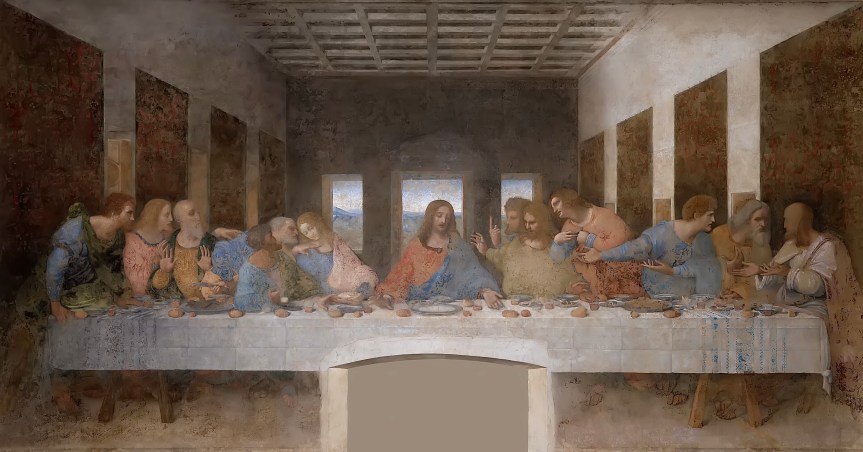
The Last Supper by Leonardo Da Vinci is one of my favorite paintings. A lot of people find hidden meanings in it. Different people have different theories about visual symbolism they say is included in the painting and what Da Vinci was trying to communicate through these things. Some of these things were highlighted and popularized in the controversial novel The Da Vinci Code by Dan Brown.

All of that aside, there is meaning to Holy Communion itself. At the traditional Passover meal depicted by Da Vinci in his masterwork, Jesus spoke words that transformed the meaning of the entire meal. When he lifted the bread, blessed and broke it, and gave it to his disciples, he proclaimed it to be his body. Then he blessed the cup, gave it to his disciples, and proclaimed it to be his blood, poured out for many for the forgiveness of their sins. Different faith traditions have attempted to explain the presence of Christ in the bread and the cup of the Sacrament. Some, like the Roman Catholic Church, believe in the doctrine of transubstantiation, which holds that the bread and the wine literally transform into the body and blood of Christ at the moment the elements are consecrated. Other traditions believe in consubstantiation, the doctrine that, essentially, the bread and the wine don’t transform into the body and blood of Christ, but that the body and the blood of Christ are literally present within them (I am oversimplifying this for the sake of brevity).

In the United Methodist Church, we understand that Christ is virtually present in the bread and the cup. The real presence of Jesus Christ is there, but we don’t know just exactly how that works. It is, therefore, a holy mystery.

Though we may not fully understand how the Sacrament of Holy Communion works, we do know this: God’s grace is mediated to us through the elements of the bread and the fruit of the vine. We come as we are to the table, the Eucharist already bought and paid for, prepared, and served, and we are invited by the Christ to come. It is more than just a memorial of the crucifixion and death of Jesus. It is a primary means of grace in Wesleyan speak. It is an essential act of worship through which God’s justifying and sanctifying grace is offered to people and can be seen at work in the human heart, an outward sign of an inward grace, imparting and imputing the righteousness of Jesus Christ to us by virtue of God’s unmerited love freely offered to all who would receive it with joy and gladness, no matter who you are, where you come from, or what you’ve done.

To this holy meal, the Lord Jesus invites you to come.

Discipleship Ain’t Cheap

25 Large crowds were traveling with Jesus. Turning to them, he said, 26 “Whoever comes to me and doesn’t hate father and mother, spouse and children, and brothers and sisters—yes, even one’s own life—cannot be my disciple. 27 Whoever doesn’t carry their own cross and follow me cannot be my disciple.
28 “If one of you wanted to build a tower, wouldn’t you first sit down and calculate the cost, to determine whether you have enough money to complete it? 29 Otherwise, when you have laid the foundation but couldn’t finish the tower, all who see it will begin to belittle you. 30 They will say, ‘Here’s the person who began construction and couldn’t complete it!’ 31 Or what king would go to war against another king without first sitting down to consider whether his ten thousand soldiers could go up against the twenty thousand coming against him? 32 And if he didn’t think he could win, he would send a representative to discuss terms of peace while his enemy was still a long way off. 33 In the same way, none of you who are unwilling to give up all of your possessions can be my disciple.

Luke 14:25-33 (CEB)

Imagine that becoming a disciple of Jesus Christ was a service available to be purchased on an online auction site like eBay.

I know, I know. It sounds ridiculous, but just go along with me on this for a minute.

You do a search for “Jesus” and suddenly you find a listing for an auction where you can bid on an opening to become Jesus’ newest disciple. You click on the link and read the following description:

Up for auction: One spot as a disciple of Jesus of Nazareth who is called CHRIST, the one and only Savior of humankind, the Holy Son of God, the Divine Word made flesh, crucified, dead and buried and resurrected on the third day. DON’T WAIT UNTIL IT’S TOO LATE!!! Secure your eternal future NOW while Jesus is still seated at the right hand of God, BEFORE he comes back to judge the living and the dead! ALL SALES ARE FINAL!!! THIS SELLER DOES NOT ACCEPT RETURNS. PLEASE READ THE AUCTION LISTING CAREFULLY BEFORE BIDDING. PAYMENT REQUIRED IMMEDIATELY! GOOD LUCK AND HAPPY BIDDING!!

Sounds good, right? Then you go to click the button to enter your bid, but you stop because you see the following:

Starting Bid: Everything You Have

You think to yourself, “That’s a high price to pay!” You begin to consider the cost. Maybe you decide to sleep on it and make a decision tomorrow. Surely no one will bid ahead of you and win the auction overnight.

When you click that “Bid” button or “Buy It Now” and you click “Submit” on a site like eBay, you are entering into an agreement to purchase the item listed for that amount should you win the auction, or for that price if it is a “Buy It Now” listing. In other words, you are making a commitment.

Discipleship is a commitment. Jesus does not ask that we give away all of our money, or that we give away all of our possessions, or that we sell all of our possessions and then give away the proceeds. Nor is Jesus actually commanding us to hate our families. The point that Jesus is making is that, in order to be one of his disciples, Jesus must be the single most important thing in your life. Our discipleship takes precedence over everything else. That does not mean that we are to neglect our families or live in poverty. Quite the opposite, in fact. However, it does mean that when anything else conflicts with our discipleship, we are called to choose our covenant relationship with Jesus over and above that other thing.

This Sunday, we will gather together once again at the table of Holy Communion. It is an outward sign of an inward grace, a sign of the covenant God has made with us through Jesus Christ. We come to the table having made a decision to enter into and honor that covenant as disciples.

Whoever you are, you have a place at that table. I hope to see you there.