What You’ve Heard and Seen

Now when John heard in prison about the things the Christ was doing, he sent word by his disciples to Jesus, asking, “Are you the one who is to come, or should we look for another?”

Jesus responded, “Go, report to John what you hear and see. Those who were blind are able to see. Those who were crippled are walking. People with skin diseases are cleansed. Those who were deaf now hear. Those who were dead are raised up. The poor have good news proclaimed to them. Happy are those who don’t stumble and fall because of me.”

When John’s disciples had gone, Jesus spoke to the crowds about John: “What did you go out to the wilderness to see? A stalk blowing in the wind? What did you go out to see? A man dressed up in refined clothes? Look, those who wear refined clothes are in royal palaces. What did you go out to see? A prophet? Yes, I tell you, and more than a prophet. He is the one of whom it is written: Look, I’m sending my messenger before you, who will prepare your way before you.

“I assure you that no one who has ever been born is greater than John the Baptist. Yet whoever is least in the kingdom of heaven is greater than he.

Matthew 11:2-11 (CEB)

So, on the Second Sunday of Advent, I preached about John the Baptist and made mention of the fact that John had no doubt in his mind about the truth of what he was preaching and no doubt about the purpose God had given him for his life. Now, on the heels of that, we have this text from Matthew where John has sent some of his disciples to ask Jesus, John’s own cousin, if he is actually the one whose coming John had been talking about before getting thrown into prison, the same Jesus whom John had himself baptized in the Jordan.

We are given the impression that John knew who Jesus was when he approached for baptism in Matthew 4 when “John tried to stop him and said, ‘I need to be baptized by you, yet you come to me?'” (v. 14). Now we read in Matthew 11 that John may not have known for sure whether or not Jesus was actually the promised Messiah. Surely some amount of time had passed between Jesus’s baptism and John’s arrest. Perhaps John’s imprisonment had cultivated some doubt in his mind about whether or not he was right about Jesus being the promised One.

Here are my thoughts on this and I would love to hear what you think: Jesus tells John’s disciples to go back and tell John about what they “hear and see” (v. 4). John baptized Jesus, but immediately after his baptism Jesus is driven by the Holy Spirit into the desert and endured temptation. After that, he would have went on about his mission, and John would not have seen him again nor would he have had occasion to witness Jesus’s work. Since John did not get to see any of Jesus’s ministry first hand, he sent his people to Jesus to find out for him. Jesus tells them, essentially, “the proof is in the pudding.” Go and tell John what they have witnessed. The blind can see. The disabled are walking. The sick are healed. The deaf hear, the dead are resurrected, and the poor (of which John was one), are offered the Good News, being put first over and above the rich elite for the first time in their lives. Jesus is doing the scandalous things that the Roman Empire and the religious leaders would be embarrassed by. If he is not the Messiah, then who else could Jesus be?

Once John heard that report, he would go on to meet his own execution knowing that he had fulfilled the purpose for his life, that he had made a pathway in the desert for God who became flesh and dwelt among us, for Emmanuel, who is God with us eternally. He would know this because people who had sought out Jesus had found him, and because Jesus had then sent them to be witnesses to John about what they had heard the Christ say and seen the Christ do.

May we go and do the same, that others may also know. O Come, O Come, Emmanuel.
Along the Border

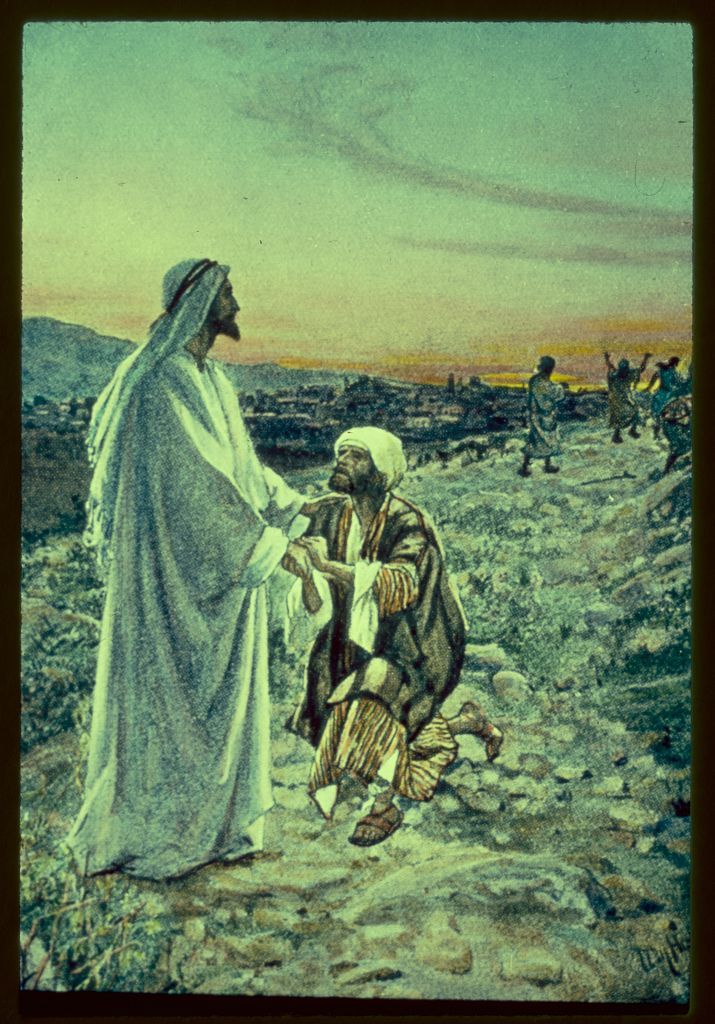
11 On the way to Jerusalem, Jesus traveled along the border between Samaria and Galilee. 12 As he entered a village, ten men with skin diseases approached him. Keeping their distance from him, 13 they raised their voices and said, “Jesus, Master, show us mercy!”
14 When Jesus saw them, he said, “Go, show yourselves to the priests.” As they left, they were cleansed. 15 One of them, when he saw that he had been healed, returned and praised God with a loud voice. 16 He fell on his face at Jesus’ feet and thanked him. He was a Samaritan. 17 Jesus replied, “Weren’t ten cleansed? Where are the other nine? 18 No one returned to praise God except this foreigner?” 19 Then Jesus said to him, “Get up and go. Your faith has healed you.”

Luke 17:11-19 (CEB)

In this text, Luke tells the story of how Jesus healed ten men of leprosy. The focus of this story is often on the fact that, out of all ten of those men, only one man came back to Jesus to give thanks for the healing and grace he received. We often consider the fact that this man was described as a “stranger” in the KJV and as a “foreigner” in more recent translations. He was a Samaritan, someone who would have been considered unclean. Luke does not tell us the ethnicity of the other nine men. It is possible that some of them were Samaritans, while others were Galileans.

All of that is interesting, but what interests me most about this text is in verse 11: “On the way to Jerusalem, Jesus traveled along the border between Samaria and Galilee.” Jesus probably could have travelled through different areas on his way to Jerusalem. Luke makes it a point to tell his readers that Jesus traveled “along the border” between these two regions, suggesting that Jesus deliberately chose this particular route over other possible routes to Jerusalem. Because Jesus chose to travel along the border, he was in a position to encounter people from both regions. Even on his way to his eventual betrayal, arrest, conviction, torture and crucifixion, Jesus chose to travel along the border, to encounter and heal along the way those whom he would soon suffer and die for. These people, who held animosity between each other for various reasons, all found healing together in the Christ.

There is a lot going on in this story, but one thing that stands out is the call upon us as disciples to travel along the border with Jesus to bring hope and healing to all who would come and receive it. The risen Christ still travels along the borders of our relationships with each other, seeking to heal our brokenness and unite us in fellowship one with another.

May we travel along the border with Jesus, in this liminal space, this in-between, and experience healing, joy, and freedom together as whole persons in Jesus Christ our Lord.

Jesus Saves, Jesus Saves

10 Jesus was teaching in one of the synagogues on the Sabbath. 11 A woman was there who had been disabled by a spirit for eighteen years. She was bent over and couldn’t stand up straight. 12 When he saw her, Jesus called her to him and said, “Woman, you are set free from your sickness.” 13 He placed his hands on her and she straightened up at once and praised God.
14 The synagogue leader, incensed that Jesus had healed on the Sabbath, responded, “There are six days during which work is permitted. Come and be healed on those days, not on the Sabbath day.”
15 The Lord replied, “Hypocrites! Don’t each of you on the Sabbath untie your ox or donkey from its stall and lead it out to get a drink? 16 Then isn’t it necessary that this woman, a daughter of Abraham, bound by Satan for eighteen long years, be set free from her bondage on the Sabbath day?” 17 When he said these things, all his opponents were put to shame, but all those in the crowd rejoiced at all the extraordinary things he was doing.

Luke 13:10-17 (CEB)

We often like to wait for the right time to do things. Maybe you’ve had someone ask you, “When are you going to do this or that?” and you answered, “I’m waiting for the right time.” Often this happens with regard to delivering some kind of news to someone that may or may not be a good thing. When a couple finds out they are having a new baby, they often wait for the right time to let everyone know the good news.

In this text, Luke reminds us that Jesus does not wait until the time is right. The woman was in the synagogue at that very moment, on that very day, and it didn’t matter to Jesus that it happened to be the Sabbath. This unnamed woman needed healing and Jesus healed her immediately, without hesitation. He didn’t pause to wonder whether it was the right time or not. He didn’t consider whether or not he should heal her since it would mean doing work on the Sabbath. He wasn’t afraid of what the synagogue leader might think if he healed her on the Sabbath. Jesus saw this woman’s need for healing and healed her. It reminds me of the old hymn “Jesus Saves”, especially the third verse:

Sing above the battle strife:
Jesus saves! Jesus saves!
By His death and endless life:
Jesus saves! Jesus saves!
Sing it softly through the gloom,
When the heart for mercy craves;
Sing in triumph o’er the tomb:
Jesus saves! Jesus saves!

https://hymnary.org/text/we_have_heard_the_joyful_sound

While the battle is still raging in our hearts and minds, Jesus does not wait. Jesus saves.

When we feel trapped in the gloom and darkness, Jesus does not wait. Jesus saves.

While our hearts are still crying out for mercy, Jesus does not wait. Jesus saves.

We can, right this very minute, stand in triumph at the mouth of the empty tomb of the resurrection and boldly proclaim, “Jesus saves, Jesus saves!” because right now is the right time.

Jesus doesn’t wait. Neither should we, because there is someone out there right now who needs healing, and Christ has no hands nor feet in this world but ours. Let us go and, through our service as disciples of Jesus Christ, proclaim to the lost, the hurting, the sick, the grieving, the hungry, the thirsty, the lonely, the broken hearted, “Jesus saves! Jesus saves!”