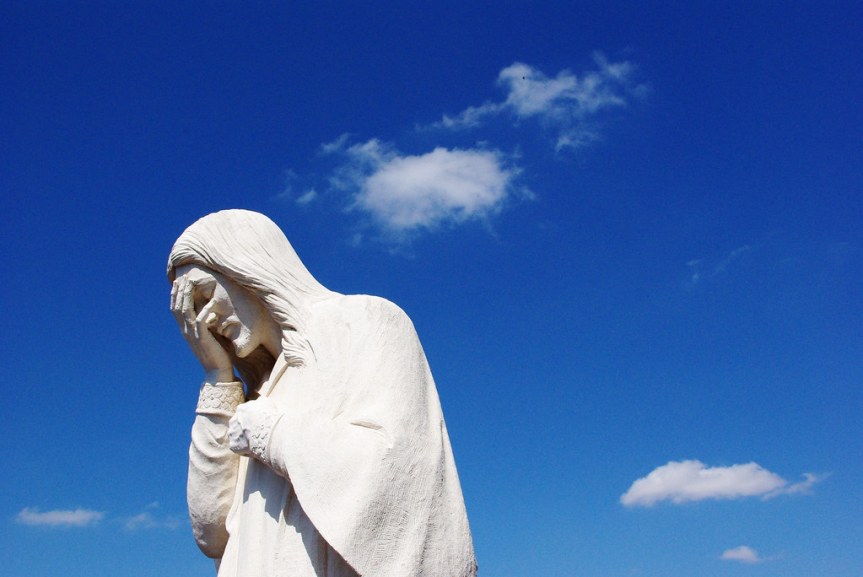
Jesus Wept

Jesus began to weep.

John 11:35 (NRSV)

Jesus began to cry.

John 11:35 (CEB)

Now Jesus wept.

John 11:35 (MSG)

Jesus wept.

John 11:35 (NIV, ESV, KJV)

It is considered the shortest verse in all of Holy Scripture. It is a verse that we don’t always give full attention to during our studies and meditations. I would like to spotlight this one verse for just a moment, for in this one verse we see the most incredible example of the full humanity of Jesus on display.

Jesus had just arrived at the tomb of Lazarus, after having waited days after initially learning of Lazarus’s illness and subsequent death before finally returning to Bethany at the behest of Mary, the sister of Lazarus. This is the same Mary who had anointed Jesus with oil and washed his feet with her hair. Now he has finally arrived to find Lazarus dead for four days already, and Mary is not happy.

Jesus, who knows what is really going on and knows that Lazarus is about walk out of the tomb, is also not happy. His friend had died, and Jesus wept.

There is no buffer here. There’s no warming up to the fact. The Fourth Evangelist simply states exactly what happened. “Jesus wept.” Even though Jesus knew he was about to resurrect Lazarus from the dead, even though Jesus knew full well that death is not the end, still he felt the sadness at the loss of his friend, and so he expressed that very human emotion by crying, just like we do.

Jesus was fully human as well as fully divine. He knew what it was like to experience loss. He understood human suffering. He understood that, even though we know as people of faith that death is not the end, we still feel the crushing sadness of grief when a loved one dies. Even though we know that resurrection is coming, we mourn.

The shortest verse in scripture reminds us that Jesus Christ mourned just like we do.

We are not alone. Thanks be to God. Amen.

The Samaritan Woman

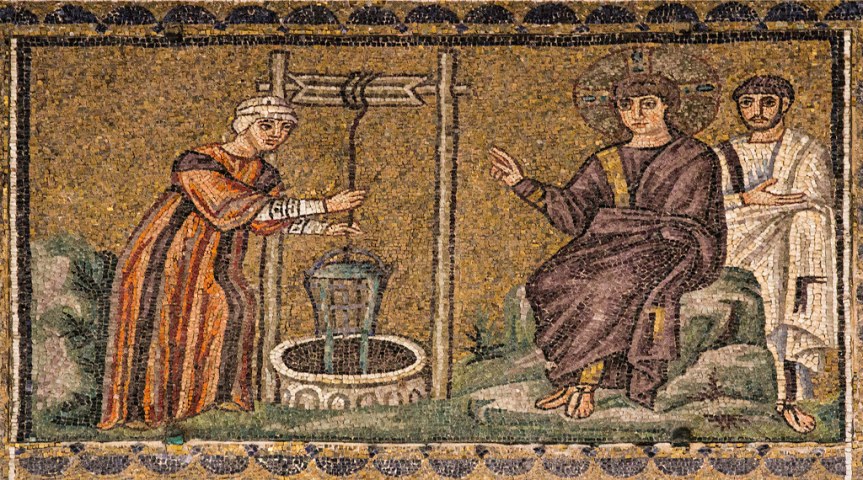
A Samaritan woman came to draw water, and Jesus said to her, “Give me a drink.” (His disciples had gone to the city to buy food.) The Samaritan woman said to him, “How is it that you, a Jew, ask a drink of me, a woman of Samaria?” (Jews do not share things in common with Samaritans.) Jesus answered her, “If you knew the gift of God, and who it is that is saying to you, ‘Give me a drink,’ you would have asked him, and he would have given you living water.” The woman said to him, “Sir, you have no bucket, and the well is deep. Where do you get that living water? Are you greater than our ancestor Jacob, who gave us the well, and with his sons and his flocks drank from it?” Jesus said to her, “Everyone who drinks of this water will be thirsty again, but those who drink of the water that I will give them will never be thirsty. The water that I will give will become in them a spring of water gushing up to eternal life.” The woman said to him, “Sir, give me this water, so that I may never be thirsty or have to keep coming here to draw water.”

John 4:7-15 (NRSV)

There are a lot of people who, if given the choice, we would not choose to talk to – people we might deem to be unworthy of our time or attention. It may be also that we simply wouldn’t choose to talk to them because we don’t know who they are and they don’t know us, so there is no real reason to stop and carry on a conversation. There could be many reasons why we would choose not to talk to someone, or to avoid someone if she or he tried to talk to us.

Jesus had every reason in the world not to talk to the Samaritan woman at Jacob’s well. Jesus had stopped to rest there because he was tired. The unnamed Samaritan woman approached the well to draw water. Jesus, being a Jewish rabbi, would not be expected to give a woman from Samaria the time of day let alone engage in a lengthy and meaningful conversation with her. Nevertheless, it was Jesus who instigated such a conversation with her at the well.

That conversation revolved around water. We today well know the significance of water to the Christian faith. Water is a symbol of life because it is life-giving. We need it to survive. Jesus tells this woman about a different kind of water. In the end, not only did this woman receive the living water Jesus told her about, but so did many others because of her story about the man she had never met before in her life, but who nevertheless told her everything she had ever done. This man couldn’t possibly be the Messiah, could he?

May we leave our buckets behind and receive the living water from the well that never runs dry during this season of Lent, and share that water with others.

The Fullness of Time

Now there was a Pharisee named Nicodemus, a leader of the Jews. He came to Jesus by night and said to him, “Rabbi, we know that you are a teacher who has come from God; for no one can do these signs that you do apart from the presence of God.” Jesus answered him, “Very truly, I tell you, no one can see the kingdom of God without being born from above.” Nicodemus said to him, “How can anyone be born after having grown old? Can one enter a second time into the mother’s womb and be born?” Jesus answered, “Very truly, I tell you, no one can enter the kingdom of God without being born of water and Spirit. What is born of the flesh is flesh, and what is born of the Spirit is spirit. Do not be astonished that I said to you, ‘You must be born from above.’ The wind blows where it chooses, and you hear the sound of it, but you do not know where it comes from or where it goes. So it is with everyone who is born of the Spirit.” Nicodemus said to him, “How can these things be?” Jesus answered him, “Are you a teacher of Israel, and yet you do not understand these things?

“Very truly, I tell you, we speak of what we know and testify to what we have seen; yet you do not receive our testimony. If I have told you about earthly things and you do not believe, how can you believe if I tell you about heavenly things? No one has ascended into heaven except the one who descended from heaven, the Son of Man. And just as Moses lifted up the serpent in the wilderness, so must the Son of Man be lifted up, that whoever believes in him may have eternal life.

“For God so loved the world that he gave his only Son, so that everyone who believes in him may not perish but may have eternal life. Indeed, God did not send the Son into the world to condemn the world, but in order that the world might be saved through him.”

John 3:1-17 (NRSV)

My long-time fascination with the idea of time travel recently lead me to a television series on Hulu called Timeless. I couldn’t believe I hadn’t seen this show before. Three people from different walks of life are recruited to be part of a team who travel in a time machine to stop the bad guys from altering events in history in order to allow them to rise to power and basically run the world. In the course of doing this, a couple of the characters decide they want to try to use the time machine to alter the past in order to save family members who had historically died in one way or another. They thought if they could go back in time and change the outcome of certain events that lead to the deaths of their loved ones, then when they returned to the present time, they would find their lost family members alive and well since the events that lead to their deaths were stopped from ever happening.

Much to their frustration, these time travelers discovered that no matter what they did to try to change past events, they were not successful in preventing the death of their family members. One of them finally succeeds, but not because of trying to do so. You will have to watch the series yourself to see what happens.

The point I find relevant in all of this is that we often wish we could go back and change things. I’ve heard people say, “If only I had a time machine, I could go back and do that differently.” We all have things we would like to change about ourselves, our past and present behavior, things we have said and done, our relationships with others, etc. Unfortunately, time machines do not exist, so we can’t go back in time to change things. Even if we could, there is no guarantee that it would change the present situation by doing so.

The only sure thing we can turn to is the power of God to transform us, to renew us through rebirth in Jesus Christ. In the fullness of time God came into the world and became one of us in order to set us free from sin and death (Galatians 4). We can allow God’s grace to take away the guilt of our past and present sin, born of the Spirit, as we repent and commit to living for God with all of our heart, soul, mind, and strength. We can’t save the world, nor will our technology ever be powerful enough to invent a machine that can, but God can and has, and God invites us to be part of the new thing God is doing in the world.

Lent in the Desert

Then Jesus was led up by the Spirit into the wilderness to be tempted by the devil. He fasted forty days and forty nights, and afterwards he was famished. The tempter came and said to him, “If you are the Son of God, command these stones to become loaves of bread.”
But he answered, “It is written,
‘One does not live by bread alone,
but by every word that comes from the mouth of God.’ ”
Then the devil took him to the holy city and placed him on the pinnacle of the temple,
saying to him, “If you are the Son of God, throw yourself down; for it is written,
‘He will command his angels concerning you,’
and ‘On their hands they will bear you up,
so that you will not dash your foot against a stone.’ ”
Jesus said to him, “Again it is written, ‘Do not put the Lord your God to the test.’ ”
Again, the devil took him to a very high mountain and showed him all the kingdoms of the world and their splendor; and he said to him, “All these I will give you, if you will fall down and worship me.”
Jesus said to him, “Away with you, Satan! for it is written,
‘Worship the Lord your God,
and serve only him.’ ”
Then the devil left him, and suddenly angels came and waited on him.

Matthew 4:1-11 (NRSV)

The Church traditionally observes the season of Lent each year for a total of forty days beginning with Ash Wednesday and ending on Easter Sunday. The Sundays in Lent “don’t count” as fast days during Lent because they are considered “little Easters” when we celebrate Christ’s ultimate victory over sin and death through the corporate worship of the gathered people of God – in other words, Sundays don’t count ’cause that’s when we go to church!

However, the rest of the days in Lent, we are thrust out into the big bad world with all of its trouble and nasty surprises just waiting to jump out and get us. It is during our time in the extreme, unforgiving conditions of the desert of life that we are tempted. Temptation may take different forms, but there is more to temptation than just the common physical things we think of when we hear the word temptation. It can be much more subtle than we might expect. For example, we all have that little voice in our head that likes to criticize us all the time. We get the idea to do something that we think would be a good idea, something that has the potential to help others, make a difference, and the little voice speaks up, “That won’t work. Why even bother trying?” Some people hear that voice a lot, and hear it enough that they are tempted to listen to that voice instead of the voice of God calling them to do a new thing.

New things don’t seem to happen out here in this desert – at least, not very often. Things tend to go along as they always have. It’s one of, if not the, universal habit of human nature: the habit of resisting change. We’ve lived our whole lives in this desert, this wilderness, and we know how things work. It’s tempting to allow that sense of superior knowledge seep into our relationship with God and convince us that, somehow, we know better because our past experience tells us so.

Maybe that’s why Jesus fasted from food from so long in the wilderness before the tempter approached him. Reminding himself, preparing himself to meet the tempter with the first words Jesus spoke to him about not living by bread alone.

But bread (understood as referring to food in general) is how we survive. We know that from experience. We have to have it or we will die. We need to make getting it and making sure we have it a priority. We better store up extra just in case. Does this sound familiar? Yet, God calls us to give it away. It is tempting to listen to the first voice and ignore the second, especially in the midst of all the threat of ruin we encounter while living in the desert.

So now we are observing Lent in the desert, since we have established that we can’t remain up on the mountain. We have chosen whatever it is we are going to give up or, alternatively, what we are going to take up as our Lenten discipline this year. We have attended Ash Wednesday and received the imposition of ashes, the stark reminder that dust we are, and unto dust we shall return. We are all prepared and ready to keep a Holy Lent, even in the midst of the wilderness and all of its nasty threats.

When the feeling of hunger (real or metaphoric) sets in, let us remember whose voice to listen to during these forty days, and may we live by every single word that voice speaks.

Amen.

Transfiguration

Six days later, Jesus took with him Peter and James and his brother John and led them up a high mountain, by themselves. And he was transfigured before them, and his face shone like the sun, and his clothes became dazzling white. Suddenly there appeared to them Moses and Elijah, talking with him. Then Peter said to Jesus, “Lord, it is good for us to be here; if you wish, I will make three dwellings here, one for you, one for Moses, and one for Elijah.” While he was still speaking, suddenly a bright cloud overshadowed them, and from the cloud a voice said, “This is my Son, the Beloved; with him I am well pleased; listen to him!” When the disciples heard this, they fell to the ground and were overcome by fear. But Jesus came and touched them, saying, “Get up and do not be afraid.” And when they looked up, they saw no one except Jesus himself alone.
As they were coming down the mountain, Jesus ordered them, “Tell no one about the vision until after the Son of Man has been raised from the dead.”

Matthew 17:1-9 (NRSV)

Six days later, three of them saw that glory. Jesus took Peter and the brothers, James and John, and led them up a high mountain. His appearance changed from the inside out, right before their eyes. Sunlight poured from his face. His clothes were filled with light. Then they realized that Moses and Elijah were also there in deep conversation with him.
Peter broke in, “Master, this is a great moment! What would you think if I built three memorials here on the mountain—one for you, one for Moses, one for Elijah?”
While he was going on like this, babbling, a light-radiant cloud enveloped them, and sounding from deep in the cloud a voice: “This is my Son, marked by my love, focus of my delight. Listen to him.”
When the disciples heard it, they fell flat on their faces, scared to death. But Jesus came over and touched them. “Don’t be afraid.” When they opened their eyes and looked around all they saw was Jesus, only Jesus.
Coming down the mountain, Jesus swore them to secrecy. “Don’t breathe a word of what you’ve seen. After the Son of Man is raised from the dead, you are free to talk.”

Matthew 17:1-9 (The Message)

This Sunday, February 19, is Transfiguration Sunday. In the church, we traditionally celebrate and observe the moment when Jesus was “transfigured” on the mountaintop in front of the disciples Peter, James and John while having a conversation with the prophets Moses and Elijah. We often reflect on such themes as the glory of Christ, what it is to be on the mountaintop and why we cannot stay there all the time, and other things.

I have included two versions of the Matthean account of the transfiguration in this week’s post. The first is from the New Revised Standard Version translation of the Bible. The second is from a version prepared by Eugene Peterson, commonly referred to as a paraphrase, known as The Message. The reason I include The Message version is because I think it clarifies for us the effect that transfiguration has on us. James and John couldn’t speak at all. Peter wanted to say something but was so awestruck that all he could say was something ridiculous. They couldn’t just stay up there on that mountain forever. Eventually, they had to go back down.

The Transfiguration is the revelation of the eternal glory of the second person of the Trinity. During Christ’s ministry on earth, his eternal glory was mostly hidden. Now, on the mountain, Christ the Redeemer is fully on display. No masks, no smoke and mirrors. This, this, is Christ the King.

The revelation of the eternal glory of the Christ is a transformative experience. As Peterson paraphrases in verse 2, Jesus’ “appearance changed from the inside out, right before their eyes.” The NRSV goes into more detail about that change. The point is, there was transformation involved.

We are transformed by the glory of the Christ. We are transformed from the inside out. It is not a surface-level change. It is not simply a mask or so much smoke and mirrors. We are not putting on a costume and pretending to be someone we are not. We come to worship on the mountaintop, to be reminded of and replenished by the glorious grace of our Lord, and then we are sent back down into the valley to live as truly and fully transformed people of God, to show forth the eternal glory of the Savior of the World to all of the people, that they may also be transformed.

As I write this, we are only six days away from Ash Wednesday and the beginning of Lent. May we contemplate during these days our own transformation as disciples of Christ and how we will keep a holy Lent so that the glory of Christ can be fully witnessed by others and that they, too, may be transformed by the grace of God from the inside out.

Follow Me

Now when Jesus heard that John had been arrested, he withdrew to Galilee. He left Nazareth and made his home in Capernaum by the sea, in the territory of Zebulun and Naphtali, so that what had been spoken through the prophet Isaiah might be fulfilled:

“Land of Zebulun, land of Naphtali,
on the road by the sea, across the Jordan, Galilee of the Gentiles—
the people who sat in darkness
have seen a great light,
and for those who sat in the region and shadow of death
light has dawned.”

From that time Jesus began to proclaim, “Repent, for the kingdom of heaven has come near.”

As he walked by the Sea of Galilee, he saw two brothers, Simon, who is called Peter, and Andrew his brother, casting a net into the sea—for they were fishermen. And he said to them, “Follow me, and I will make you fish for people.” Immediately they left their nets and followed him. As he went from there, he saw two other brothers, James son of Zebedee and his brother John, in the boat with their father Zebedee, mending their nets, and he called them. Immediately they left the boat and their father, and followed him.

Jesus went throughout Galilee, teaching in their synagogues and proclaiming the good news of the kingdom and curing every disease and every sickness among the people.

Matthew 4:12-23

If you’ve ever tried fishing, you know how relaxing it can be. If you’ve ever tried fishing, you also know how frustrating it can be. I will save the story I’m thinking of for this Sunday’s sermon, but I’m sure you can recall your own stories about fishing. Maybe you went fishing with your family as a child. Maybe you took your own children fishing a time or two.

I’m guessing most people try to keep fishing simple: a pole, a reel, a line, a hook, and bait. Cast out into the water. Sit there and wait to see what happens. That’s how we always did it when I was a kid. Today, I sometimes see people using expensive boats, rods and reels, tackle boxes, etc. While Angie and I were on vacation in Louisiana, we took a swamp boat tour. The boat our guide took us out in was a long flat-bottom shrimp boat. We noticed another man putting out in the water from the same ramp we used, but in a very expensive “bass boat”. He had all kinds of trouble just getting out into the open water. His engine kept giving him trouble. He had trouble turning the boat around. He had to stop several times to work on it. In the meantime, people in small, cheap, beat-up boats with basic outboard motors were getting out with no problems.

Thank God that Jesus does not require us to have any kind of expensive, fancy equipment to be able to follow him. We don’t need any fancy tools to be, as Jesus calls us, “fishers of people.” We don’t need to be bogged down in complexity to follow Christ and bring others along with us. We need only follow Jesus with repentant hearts, willing spirits, loving God with all that we are and loving our neighbor as ourselves. All we need is to proclaim the good news of the kingdom in ways that are welcoming and healing, reminding people that we aren’t trying to hook and reel them into something. Rather, we are inviting them to join us in the sometimes rough waters of life with Jesus who teaches us a new way to live.

The Galilean fishermen in Matthew 4 did not hesitate to follow Jesus. Matthew tells us that, “Immediately they left their nets and followed him.” May we follow suit while inviting others to do the same.

What About Joseph?

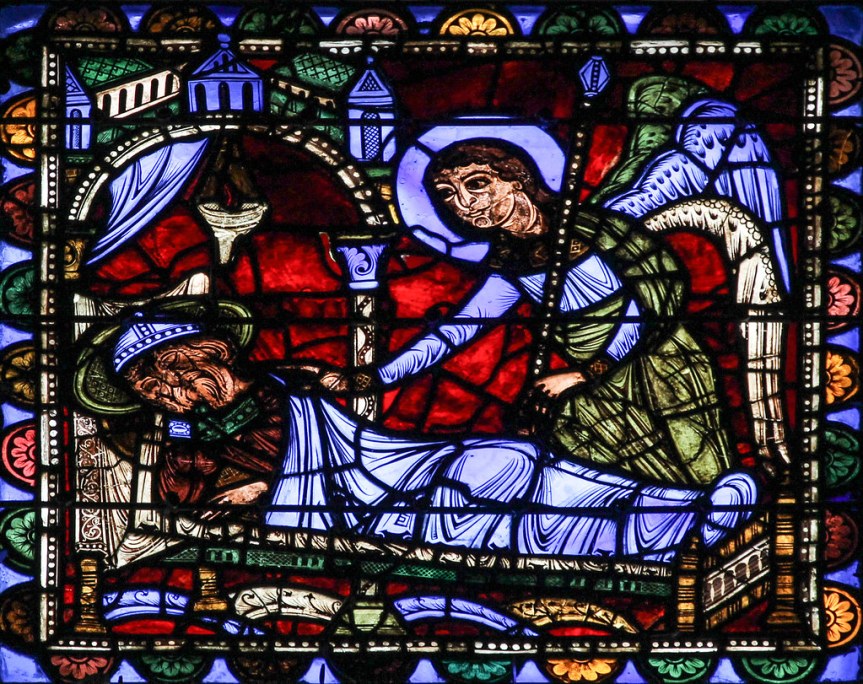
Now the birth of Jesus the Messiah took place in this way. When his mother Mary had been engaged to Joseph, but before they lived together, she was found to be with child from the Holy Spirit. Her husband Joseph, being a righteous man and unwilling to expose her to public disgrace, planned to dismiss her quietly. But just when he had resolved to do this, an angel of the Lord appeared to him in a dream and said, “Joseph, son of David, do not be afraid to take Mary as your wife, for the child conceived in her is from the Holy Spirit. She will bear a son, and you are to name him Jesus, for he will save his people from their sins.” All this took place to fulfill what had been spoken by the Lord through the prophet:

“Look, the virgin shall conceive and bear a son,
and they shall name him Emmanuel,”
which means, “God is with us.”

When Joseph awoke from sleep, he did as the angel of the Lord commanded him; he took her as his wife, but had no marital relations with her until she had borne a son; and he named him Jesus.

Matthew 1:18-25 (NRSV)

We are just over one week away from Christmas. This coming Sunday, December 18, we will celebrate the Fourth Sunday of Advent. It seems like just last week was the first Sunday in July. Time certainly does fly!

I wonder if time was flying by for Joseph. We focus so much on Mary during Advent and Christmas that we often forget to think much about Joseph. After Joseph had learned of Mary’s pregnancy and agonized over what to do about it, he had decided to divorce her quietly in order to spare her and her family the shame that would come upon her house if he publicly exposed Mary as having committed adultery. But then an angel came to Joseph in a dream and told him the truth about Mary and the child she carried. The angel told Joseph to name him Jesus because he would save God’s people from their sins.

So, Joseph had a big decision to make. Should he proceed with his original plan to end his marriage to Mary in a way that would keep the blame off of her, or should he listen to this messenger from God, stay with Mary, name her child Jesus and raise him as Joseph’s own?

In the end, Joseph decided to follow the instructions of the angel. They named the child Jesus. They had to go through a lot, and Joseph was there every step of the way. He put aside his own feelings and impulses and chose to follow God in a way that must not have made much sense to Joseph at the time. Joseph’s deep relationship with God was stronger than any doubts Joseph may have had.

Because Joseph chose to follow God instead of his own ideas, we still today choose to follow God as disciples of that Holy Child who was conceived of the Holy Spirit, born of the Virgin Mary, suffered under Pontius Pilate, was crucified, dead and buried, and on the third day rose from the dead and ascended into heaven to sit at the right hand of God the Creator Almighty.

Let us give thanks this Advent and Christmas for God’s calling on the lives of so many, especially Joseph and Mary, and for their child, who spent his first night on earth sleeping in a farm animal’s feeding trough, and who we now are blessed to call Christ our Lord.

What You’ve Heard and Seen

Now when John heard in prison about the things the Christ was doing, he sent word by his disciples to Jesus, asking, “Are you the one who is to come, or should we look for another?”

Jesus responded, “Go, report to John what you hear and see. Those who were blind are able to see. Those who were crippled are walking. People with skin diseases are cleansed. Those who were deaf now hear. Those who were dead are raised up. The poor have good news proclaimed to them. Happy are those who don’t stumble and fall because of me.”

When John’s disciples had gone, Jesus spoke to the crowds about John: “What did you go out to the wilderness to see? A stalk blowing in the wind? What did you go out to see? A man dressed up in refined clothes? Look, those who wear refined clothes are in royal palaces. What did you go out to see? A prophet? Yes, I tell you, and more than a prophet. He is the one of whom it is written: Look, I’m sending my messenger before you, who will prepare your way before you.

“I assure you that no one who has ever been born is greater than John the Baptist. Yet whoever is least in the kingdom of heaven is greater than he.

Matthew 11:2-11 (CEB)

So, on the Second Sunday of Advent, I preached about John the Baptist and made mention of the fact that John had no doubt in his mind about the truth of what he was preaching and no doubt about the purpose God had given him for his life. Now, on the heels of that, we have this text from Matthew where John has sent some of his disciples to ask Jesus, John’s own cousin, if he is actually the one whose coming John had been talking about before getting thrown into prison, the same Jesus whom John had himself baptized in the Jordan.

We are given the impression that John knew who Jesus was when he approached for baptism in Matthew 4 when “John tried to stop him and said, ‘I need to be baptized by you, yet you come to me?'” (v. 14). Now we read in Matthew 11 that John may not have known for sure whether or not Jesus was actually the promised Messiah. Surely some amount of time had passed between Jesus’s baptism and John’s arrest. Perhaps John’s imprisonment had cultivated some doubt in his mind about whether or not he was right about Jesus being the promised One.

Here are my thoughts on this and I would love to hear what you think: Jesus tells John’s disciples to go back and tell John about what they “hear and see” (v. 4). John baptized Jesus, but immediately after his baptism Jesus is driven by the Holy Spirit into the desert and endured temptation. After that, he would have went on about his mission, and John would not have seen him again nor would he have had occasion to witness Jesus’s work. Since John did not get to see any of Jesus’s ministry first hand, he sent his people to Jesus to find out for him. Jesus tells them, essentially, “the proof is in the pudding.” Go and tell John what they have witnessed. The blind can see. The disabled are walking. The sick are healed. The deaf hear, the dead are resurrected, and the poor (of which John was one), are offered the Good News, being put first over and above the rich elite for the first time in their lives. Jesus is doing the scandalous things that the Roman Empire and the religious leaders would be embarrassed by. If he is not the Messiah, then who else could Jesus be?

Once John heard that report, he would go on to meet his own execution knowing that he had fulfilled the purpose for his life, that he had made a pathway in the desert for God who became flesh and dwelt among us, for Emmanuel, who is God with us eternally. He would know this because people who had sought out Jesus had found him, and because Jesus had then sent them to be witnesses to John about what they had heard the Christ say and seen the Christ do.

May we go and do the same, that others may also know. O Come, O Come, Emmanuel.

Sticking Out Like A Sore Thumb

In those days, John the Baptist appeared in the wilderness of Judea, proclaiming, “Repent, for the kingdom of heaven has come near.”

This is the one of whom the prophet Isaiah spoke when he said, “The voice of one crying out in the wilderness: ‘Prepare the way of the Lord, make his paths straight.'”

Now John wore clothing of camel’s hair with a leather belt around his waist, and his food was locusts and wild honey. Then the people of Jerusalem and all Judea were going out to him, and all the region along the Jordan, and they were baptized by him in the river Jordan, confessing their sins.

But when he saw many Pharisees and Sadducees coming for baptism, he said to them, “You brood of vipers! Who warned you to flee from the wrath to come? Bear fruit worthy of repentance. Do not presume to say to yourselves, ‘We have Abraham as our ancestor’; for I tell you, God is able from these stones to raise up children to Abraham. Even now the ax is lying at the root of the trees; every tree therefore that does not bear good fruit is cut down and thrown into the fire.

“I baptize you with water for repentance, but one who is more powerful than I is coming after me; I am not worthy to carry his sandals. He will baptize you with the Holy Spirit and fire.”

Matthew 3:1-11 (NRSV)

This is the first blog update in a few weeks because of my inability to login and access the website. Thankfully, we have that fixed and now I can get back to regular weekly updates.

By the standards of people in first century Judea, John the Baptist was a weirdo. He stuck out like a sore thumb. I don’t know the exact origins of the idiom “stick out like a sore thumb,” but it usually is used to describe something that is clearly out of place and does not match its surroundings. John the Baptist certainly fit that description. He did not seem concerned with making himself look like other people. He did not seem concerned with acting like other people. Instead, he was focused on his mission to “prepare the way of the Lord.”

When the Pharisees and Sadducees showed up, he did not cut them any slack. He called them a “brood of vipers” (think “den of snakes”) and proceeded to tell them how the cow ate the cabbage, so to speak. John the Baptist doesn’t sound like the shining example of how to win friends and influence people, yet people from all over the countryside were coming to him for baptism in the Jordan.

What was his secret? Well, he was following God’s calling on his life for one thing. Another thing is that he was singularly focused on his mission. One of the most important things about John the Baptist though is that he was not afraid to just be himself.

He wasn’t weird just because of what he wore as clothing or what he ate as food. John was weird because, in a world of so many people who were so concerned with keeping up appearances, John just went along being his authentic self.

How often do we just allow ourselves to be our authentic selves? What kind of pressures do we face in life to present ourselves in a certain way? Who has God created us to be and how are we reflecting that to the world?

There is an old movie from the 80’s called “The Breakfast Club.” I’m sure you’ve seen it. Some teenagers get stuck in detention together after school and the whole movie is about how they relate to each other and the trouble they get themselves, and each other, into before they are allowed to leave. Each character is unique, and each one presents to the other as her or his authentic self. Through doing so they gain new understandings of each other and are changed in ways that make them better people. When John the Baptist preached repentance, from the Greek word metanoia meaning “change of heart and life”, what if he was telling the people, at least in part, to stop pretending and just be who God created them to be? That’s what John was doing. That’s what Jesus did.

Let us go with the confidence of children of God and do the same. Amen.

New Creation

17 For I am about to create new heavens
and a new earth;
the former things shall not be remembered
or come to mind.
18 But be glad and rejoice forever
in what I am creating;
for I am about to create Jerusalem as a joy,
and its people as a delight.
19 I will rejoice in Jerusalem,
and delight in my people;
no more shall the sound of weeping be heard in it,
or the cry of distress.
20 No more shall there be in it
an infant that lives but a few days,
or an old person who does not live out a lifetime;
for one who dies at a hundred years will be considered a youth,
and one who falls short of a hundred will be considered accursed.
21 They shall build houses and inhabit them;
they shall plant vineyards and eat their fruit.
22 They shall not build and another inhabit;
they shall not plant and another eat;
for like the days of a tree shall the days of my people be,
and my chosen shall long enjoy the work of their hands.
23 They shall not labor in vain,
or bear children for calamity;
for they shall be offspring blessed by the LORD—
and their descendants as well.
24 Before they call I will answer,
while they are yet speaking I will hear.
25 The wolf and the lamb shall feed together,
the lion shall eat straw like the ox;
but the serpent—its food shall be dust!
They shall not hurt or destroy
on all my holy mountain,
says the LORD.

Isaiah 65:17-25

It might interest you to know that while writing this blog post I had a strange thing happen with my computer and I lost the entire post before I could publish it. So, let’s try this again!

We are drawing near to the beginning of the season of Advent, which is supposed to be a time of anticipation, expectation, and waiting. The question is: What exactly are we anticipating? What exactly are we expecting? What is it exactly that we are waiting for?

The first obvious answer is that we are waiting for the coming of the Messiah with great anticipation and expectation. That is the central hope of Advent. The coming Christ will save us from sin and death and afford us the great hope of resurrection and life everlasting.

The second answer which we may not always think about is what Isaiah is talking about here. The coming Messiah will not just save us from our sins, but will usher the inbreaking of the kingdom of God into the world. It marks the beginning of God initiating a new act of creation. Isaiah refers to things that people experience in life, things that bring pain and suffering, and turns them completely upside down. This is what God is doing in this new creation: Turning this broken world upside down, rebuilding what has been destroyed, and recreating in us God’s image in which we were first created. Isaiah describes what this new creation will look like and how it will operate, which is completely the opposite of what we know.

So, not only are we waiting expectantly with great anticipation for the coming Christ, but we are also waiting, expecting, and anticipating with joy the new thing God is doing.

May we seek to be a part of that new creation not only during Advent, but every day that God has given us.