
Sticking Out Like A Sore Thumb

In those days, John the Baptist appeared in the wilderness of Judea, proclaiming, “Repent, for the kingdom of heaven has come near.”

This is the one of whom the prophet Isaiah spoke when he said, “The voice of one crying out in the wilderness: ‘Prepare the way of the Lord, make his paths straight.'”

Now John wore clothing of camel’s hair with a leather belt around his waist, and his food was locusts and wild honey. Then the people of Jerusalem and all Judea were going out to him, and all the region along the Jordan, and they were baptized by him in the river Jordan, confessing their sins.

But when he saw many Pharisees and Sadducees coming for baptism, he said to them, “You brood of vipers! Who warned you to flee from the wrath to come? Bear fruit worthy of repentance. Do not presume to say to yourselves, ‘We have Abraham as our ancestor’; for I tell you, God is able from these stones to raise up children to Abraham. Even now the ax is lying at the root of the trees; every tree therefore that does not bear good fruit is cut down and thrown into the fire.

“I baptize you with water for repentance, but one who is more powerful than I is coming after me; I am not worthy to carry his sandals. He will baptize you with the Holy Spirit and fire.”

Matthew 3:1-11 (NRSV)

This is the first blog update in a few weeks because of my inability to login and access the website. Thankfully, we have that fixed and now I can get back to regular weekly updates.

By the standards of people in first century Judea, John the Baptist was a weirdo. He stuck out like a sore thumb. I don’t know the exact origins of the idiom “stick out like a sore thumb,” but it usually is used to describe something that is clearly out of place and does not match its surroundings. John the Baptist certainly fit that description. He did not seem concerned with making himself look like other people. He did not seem concerned with acting like other people. Instead, he was focused on his mission to “prepare the way of the Lord.”

When the Pharisees and Sadducees showed up, he did not cut them any slack. He called them a “brood of vipers” (think “den of snakes”) and proceeded to tell them how the cow ate the cabbage, so to speak. John the Baptist doesn’t sound like the shining example of how to win friends and influence people, yet people from all over the countryside were coming to him for baptism in the Jordan.

What was his secret? Well, he was following God’s calling on his life for one thing. Another thing is that he was singularly focused on his mission. One of the most important things about John the Baptist though is that he was not afraid to just be himself.

He wasn’t weird just because of what he wore as clothing or what he ate as food. John was weird because, in a world of so many people who were so concerned with keeping up appearances, John just went along being his authentic self.

How often do we just allow ourselves to be our authentic selves? What kind of pressures do we face in life to present ourselves in a certain way? Who has God created us to be and how are we reflecting that to the world?

There is an old movie from the 80’s called “The Breakfast Club.” I’m sure you’ve seen it. Some teenagers get stuck in detention together after school and the whole movie is about how they relate to each other and the trouble they get themselves, and each other, into before they are allowed to leave. Each character is unique, and each one presents to the other as her or his authentic self. Through doing so they gain new understandings of each other and are changed in ways that make them better people. When John the Baptist preached repentance, from the Greek word metanoia meaning “change of heart and life”, what if he was telling the people, at least in part, to stop pretending and just be who God created them to be? That’s what John was doing. That’s what Jesus did.

Let us go with the confidence of children of God and do the same. Amen.
New Creation

17 For I am about to create new heavens
and a new earth;
the former things shall not be remembered
or come to mind.
18 But be glad and rejoice forever
in what I am creating;
for I am about to create Jerusalem as a joy,
and its people as a delight.
19 I will rejoice in Jerusalem,
and delight in my people;
no more shall the sound of weeping be heard in it,
or the cry of distress.
20 No more shall there be in it
an infant that lives but a few days,
or an old person who does not live out a lifetime;
for one who dies at a hundred years will be considered a youth,
and one who falls short of a hundred will be considered accursed.
21 They shall build houses and inhabit them;
they shall plant vineyards and eat their fruit.
22 They shall not build and another inhabit;
they shall not plant and another eat;
for like the days of a tree shall the days of my people be,
and my chosen shall long enjoy the work of their hands.
23 They shall not labor in vain,
or bear children for calamity;
for they shall be offspring blessed by the LORD—
and their descendants as well.
24 Before they call I will answer,
while they are yet speaking I will hear.
25 The wolf and the lamb shall feed together,
the lion shall eat straw like the ox;
but the serpent—its food shall be dust!
They shall not hurt or destroy
on all my holy mountain,
says the LORD.

Isaiah 65:17-25

It might interest you to know that while writing this blog post I had a strange thing happen with my computer and I lost the entire post before I could publish it. So, let’s try this again!

We are drawing near to the beginning of the season of Advent, which is supposed to be a time of anticipation, expectation, and waiting. The question is: What exactly are we anticipating? What exactly are we expecting? What is it exactly that we are waiting for?

The first obvious answer is that we are waiting for the coming of the Messiah with great anticipation and expectation. That is the central hope of Advent. The coming Christ will save us from sin and death and afford us the great hope of resurrection and life everlasting.

The second answer which we may not always think about is what Isaiah is talking about here. The coming Messiah will not just save us from our sins, but will usher the inbreaking of the kingdom of God into the world. It marks the beginning of God initiating a new act of creation. Isaiah refers to things that people experience in life, things that bring pain and suffering, and turns them completely upside down. This is what God is doing in this new creation: Turning this broken world upside down, rebuilding what has been destroyed, and recreating in us God’s image in which we were first created. Isaiah describes what this new creation will look like and how it will operate, which is completely the opposite of what we know.

So, not only are we waiting expectantly with great anticipation for the coming Christ, but we are also waiting, expecting, and anticipating with joy the new thing God is doing.

May we seek to be a part of that new creation not only during Advent, but every day that God has given us.

Renovation

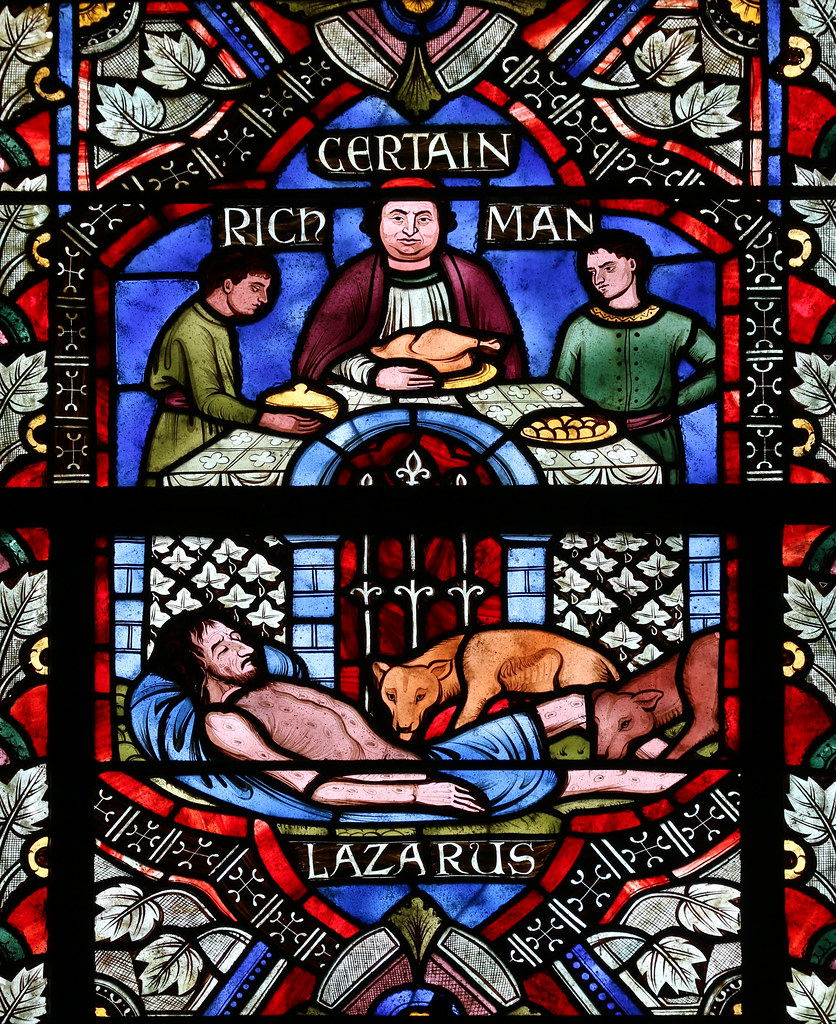
19 “There was a certain rich man who clothed himself in purple and fine linen, and who feasted luxuriously every day. 20 At his gate lay a certain poor man named Lazarus who was covered with sores. 21 Lazarus longed to eat the crumbs that fell from the rich man’s table. Instead, dogs would come and lick his sores.
22 “The poor man died and was carried by angels to Abraham’s side. The rich man also died and was buried. 23 While being tormented in the place of the dead, he looked up and saw Abraham at a distance with Lazarus at his side. 24 He shouted, ‘Father Abraham, have mercy on me. Send Lazarus to dip the tip of his finger in water and cool my tongue, because I’m suffering in this flame.’ 25 But Abraham said, ‘Child, remember that during your lifetime you received good things, whereas Lazarus received terrible things. Now Lazarus is being comforted and you are in great pain. 26 Moreover, a great crevasse has been fixed between us and you. Those who wish to cross over from here to you cannot. Neither can anyone cross from there to us.’
27 “The rich man said, ‘Then I beg you, Father, send Lazarus to my father’s house. 28 I have five brothers. He needs to warn them so that they don’t come to this place of agony.’ 29 Abraham replied, ‘They have Moses and the Prophets. They must listen to them.’ 30 The rich man said, ‘No, Father Abraham! But if someone from the dead goes to them, they will change their hearts and lives.’ 31 Abraham said, ‘If they don’t listen to Moses and the Prophets, then neither will they be persuaded if someone rises from the dead.’”

Luke 16:19-31 (CEB)

Let’s face it: Nobody wants to be Lazarus. His situation in this story is absolutely miserable. Who could imagine living their life that way every single day, day in and day out? After reading only the first part of this parable and then having to choose which of these two men a person would rather be, almost everyone would most likely choose the rich man. Perhaps it’s because we tend to focus on the reality of what is right in front of us at the time.

As I write this, I’m sitting with Angie at our house in Greenbrier watching a show about home renovation. The show follows people who buy old, dilapidated houses and renovates them while still maintaining the historical value of the homes. I’m not a home-renovation person myself. I wouldn’t even know where to start, but from watching shows like this one I understand that renovation is necessary not only to make a place livable but also to safeguard the history of the home and how it got to be there in the first place.

To cultivate a mindset in the here-and-now that allows us to see the value of being Lazarus over and above the immediate benefits of being the rich man requires a certain amount of renovation of ourselves. What is right in front of us may look very appetizing, satisfying, etc., we allow the Spirit of God to renovate our hearts and minds to see that what is now will not always be. At the same time, however, we remember where we were, where we came from in the first place. We retain the memory of who we were when we were the rich man, and we embrace the newness of life that comes with seeing the eternal value of being Lazarus.

But how does one actually choose to be Lazarus? Remember, we are speaking in allegories here. No one in their right mind would choose Lazarus’s position in this story, and that is completely understandable. Among other possibilities, I think this story invites us to consider what walls need to be torn down or revamped in the renovation of ourselves, and what changes we need to make in how we see the world and the other people in it as we allow God’s sanctifying grace to work in our hearts until that day when Christ comes in final victory and we all — rich and poor and everyone in between — feast at his heavenly banquet. Until then, we live in this liminal space where one day we feel more like the rich man and the next day we feel more like Lazarus, all the while being reminded that we are all one in Christ Jesus.

Jesus Saves, Jesus Saves

10 Jesus was teaching in one of the synagogues on the Sabbath. 11 A woman was there who had been disabled by a spirit for eighteen years. She was bent over and couldn’t stand up straight. 12 When he saw her, Jesus called her to him and said, “Woman, you are set free from your sickness.” 13 He placed his hands on her and she straightened up at once and praised God.
14 The synagogue leader, incensed that Jesus had healed on the Sabbath, responded, “There are six days during which work is permitted. Come and be healed on those days, not on the Sabbath day.”
15 The Lord replied, “Hypocrites! Don’t each of you on the Sabbath untie your ox or donkey from its stall and lead it out to get a drink? 16 Then isn’t it necessary that this woman, a daughter of Abraham, bound by Satan for eighteen long years, be set free from her bondage on the Sabbath day?” 17 When he said these things, all his opponents were put to shame, but all those in the crowd rejoiced at all the extraordinary things he was doing.

Luke 13:10-17 (CEB)

We often like to wait for the right time to do things. Maybe you’ve had someone ask you, “When are you going to do this or that?” and you answered, “I’m waiting for the right time.” Often this happens with regard to delivering some kind of news to someone that may or may not be a good thing. When a couple finds out they are having a new baby, they often wait for the right time to let everyone know the good news.

In this text, Luke reminds us that Jesus does not wait until the time is right. The woman was in the synagogue at that very moment, on that very day, and it didn’t matter to Jesus that it happened to be the Sabbath. This unnamed woman needed healing and Jesus healed her immediately, without hesitation. He didn’t pause to wonder whether it was the right time or not. He didn’t consider whether or not he should heal her since it would mean doing work on the Sabbath. He wasn’t afraid of what the synagogue leader might think if he healed her on the Sabbath. Jesus saw this woman’s need for healing and healed her. It reminds me of the old hymn “Jesus Saves”, especially the third verse:

Sing above the battle strife:
Jesus saves! Jesus saves!
By His death and endless life:
Jesus saves! Jesus saves!
Sing it softly through the gloom,
When the heart for mercy craves;
Sing in triumph o’er the tomb:
Jesus saves! Jesus saves!

https://hymnary.org/text/we_have_heard_the_joyful_sound

While the battle is still raging in our hearts and minds, Jesus does not wait. Jesus saves.

When we feel trapped in the gloom and darkness, Jesus does not wait. Jesus saves.

While our hearts are still crying out for mercy, Jesus does not wait. Jesus saves.

We can, right this very minute, stand in triumph at the mouth of the empty tomb of the resurrection and boldly proclaim, “Jesus saves, Jesus saves!” because right now is the right time.

Jesus doesn’t wait. Neither should we, because there is someone out there right now who needs healing, and Christ has no hands nor feet in this world but ours. Let us go and, through our service as disciples of Jesus Christ, proclaim to the lost, the hurting, the sick, the grieving, the hungry, the thirsty, the lonely, the broken hearted, “Jesus saves! Jesus saves!”

Learning To Count

1After these events, the LORD’s word came to Abram in a vision, “Don’t be afraid, Abram. I am your protector. Your reward will be very great.”
2 But Abram said, “LORD God, what can you possibly give me, since I still have no children? The head of my household is Eliezer, a man from Damascus.” 3 He continued, “Since you haven’t given me any children, the head of my household will be my heir.”
4 The LORD’s word came immediately to him, “This man will not be your heir. Your heir will definitely be your very own biological child.” 5 Then he brought Abram outside and said, “Look up at the sky and count the stars if you think you can count them.” He continued, “This is how many children you will have.” 6 Abram trusted the LORD, and the LORD recognized Abram’s high moral character.

Genesis 15:1-6 (CEB)

It used to fascinate me that there were people who had memorized Pi out to so many digits. If you are reading this and are not familiar with Pi, here is Pi listed out to 1000 decimal places:

3.14159265358979323846264338327950288419716939937510
  58209749445923078164062862089986280348253421170679
  82148086513282306647093844609550582231725359408128
  48111745028410270193852110555964462294895493038196
  44288109756659334461284756482337867831652712019091
  45648566923460348610454326648213393607260249141273
  72458700660631558817488152092096282925409171536436
  78925903600113305305488204665213841469519415116094
  33057270365759591953092186117381932611793105118548
  07446237996274956735188575272489122793818301194912
  98336733624406566430860213949463952247371907021798
  60943702770539217176293176752384674818467669405132
  00056812714526356082778577134275778960917363717872
  14684409012249534301465495853710507922796892589235
  42019956112129021960864034418159813629774771309960
  51870721134999999837297804995105973173281609631859
  50244594553469083026425223082533446850352619311881
  71010003137838752886587533208381420617177669147303
  59825349042875546873115956286388235378759375195778
  18577805321712268066130019278766111959092164201989

That’s a lot! If you search further on the internet, you can find Pi written out even further. Here is a link to Pi out to 100,000 digits: http://www.geom.uiuc.edu/~huberty/math5337/groupe/digits.html Take a moment to click on this link and see if you can count the digits yourself. Then come back here.

Were you able to do it? Even though that expression of Pi stops after “only” 100,000 places, you probably were not able to count them all. I tried, but stopped after only a few digits. For me, it was the enormity of the task before me, and the sense that trying to count all of those digits just didn’t make any sense, nor did it serve any useful purpose as far as I could see.

In Genesis 15, God hears Abram’s concern about not having an heir. Abram decides that he is going to simply leave everything to Eliezer, the head of his household. God, however, has other ideas for Abram and Sarai.

So, to make a point, God instructs Abram to go outside and try to count the number of stars in the sky, if he thinks he can do it. The thing about the stars as they appear to us from earth is that they seem to keep appearing out of nowhere as our eyes acclimate to the darkness. It’s just like Pi: just when you think you have made progress, you are reminded that Pi is a non-terminating number. In other words, the digits of Pi go on forever. No one can ever possibly hope to count them all simply because there is no “all”. From our vantage point, there is no “all” with regard to the stars in the heavens, and with God, there is also no “all”.

God is infinite by nature and eternally existent.

God has no beginning and no end. Nor will God ever have an end. It is impossible to count the years, ages or eons of God because God exists outside of our concept of time. We express this concept of the nature of God in short by saying that God is eternal. It is also well worth reminding ourselves that God is also infinite, which is another way of saying that God has no end. We can no more measure the totality of God’s being than we can count all the digits of Pi, no more than we can count all the stars in the heavens. Our God is not an awesome God just because of how God loves us. Our God is an awesome God simply because God is.

God’s creative involvement in our finite human existence is incapable of being measured or counted and needs no qualification.

In some ways, Abram was misunderstanding God’s nature by proclaiming his decision to leave everything to his head of household Eliezer. Abram only decided to do this because he believed it was impossible for him to ever conceive a child with his wife Sarai based on Abram’s advanced age (which is capable of being counted and measured) and the physical condition of Sarai (which is also capable of being observed, quantified, and documented) with regard to the possibility of pregnancy. Abram’s limited understanding of the world and of the nature of God made it virtually impossible for Abram to see past the physical limitations of his own finite human nature to imagine anything being possible beyond what his own experience could confirm and support.

God, however, is. Thus, God is not limited to the same constraints we humans are. God’s vision of what is possible is unlimited. God’s creative power is limitless. As the great preacher Rev. S.M. Lockridge once said in a famous sermon about the nature of the Christ, “No far-seeing telescope can bring into visibility the coastline of his shoreless supply.” That’s because there is no coastline. There is no limit to God’s love for God’s creation, of which we are an integral part, made in the very image of God.

Abram and Sarai did end up having a child. In Genesis 17, God would tell Abram, I am El Shaddai,” and give them both new names: Abraham and Sarah, and Sarah would go on to give birth to Issac. In Exodus, God would say to Moses, “I AM who I AM. So say to the Israelites, ‘I AM has sent me to you,'” (Exodus 3:14) and Moses would go on to lead God’s people out of Egyptian bondage. In the Gospel narrative, Jesus would tell his disciples, “I am the bread of life. Whoever comes to me will never go hungry, and whoever believes in me will never be thirsty” (John 6:35) and again in John 9, “While I am in the world, I am the light of the world,” and then he used the dirt of the earth and the spit of his own mouth to make mud and gave sight to a blind man.

Go outside tonight. Bring what is bothering you along. Look up at the night sky, find a star, and start counting. Count until the stars become blurry from tears of joy and you just stop counting. Be reminded of the eternal, infinite, limitless nature of God and God’s love for you, a love that cannot be counted but can always be counted on, and that come death or hell or high water, God always has been, is now, and always will be, the great I AM.