26 While they were eating, Jesus took bread, blessed it, broke it, and gave it to the disciples and said, “Take and eat. This is my body.” 27 He took a cup, gave thanks, and gave it to them, saying, “Drink from this, all of you. 28 This is my blood of the covenant, which is poured out for many so that their sins may be forgiven. 29 I tell you, I won’t drink wine again until that day when I drink it in a new way with you in my Father’s kingdom.” 30 Then, after singing songs of praise, they went to the Mount of Olives.
Matthew 26:26-30 (CEB)
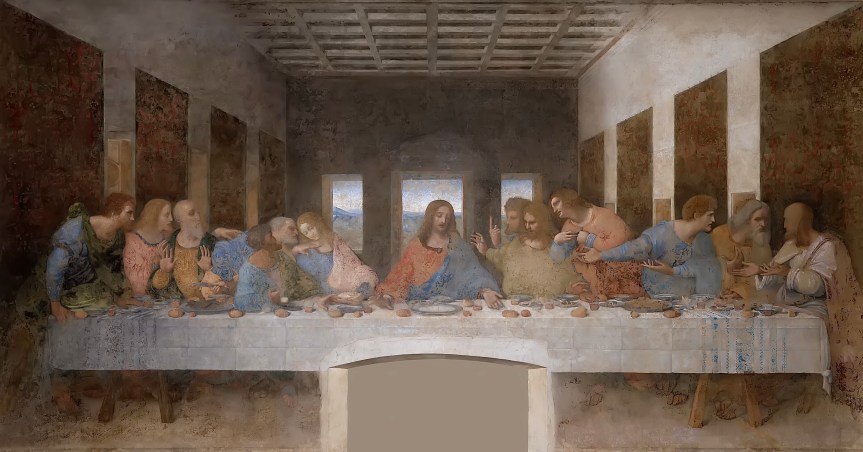
The Last Supper by Leonardo Da Vinci is one of my favorite paintings. A lot of people find hidden meanings in it. Different people have different theories about visual symbolism they say is included in the painting and what Da Vinci was trying to communicate through these things. Some of these things were highlighted and popularized in the controversial novel The Da Vinci Code by Dan Brown.
All of that aside, there is meaning to Holy Communion itself. At the traditional Passover meal depicted by Da Vinci in his masterwork, Jesus spoke words that transformed the meaning of the entire meal. When he lifted the bread, blessed and broke it, and gave it to his disciples, he proclaimed it to be his body. Then he blessed the cup, gave it to his disciples, and proclaimed it to be his blood, poured out for many for the forgiveness of their sins. Different faith traditions have attempted to explain the presence of Christ in the bread and the cup of the Sacrament. Some, like the Roman Catholic Church, believe in the doctrine of transubstantiation, which holds that the bread and the wine literally transform into the body and blood of Christ at the moment the elements are consecrated. Other traditions believe in consubstantiation, the doctrine that, essentially, the bread and the wine don’t transform into the body and blood of Christ, but that the body and the blood of Christ are literally present within them (I am oversimplifying this for the sake of brevity).
In the United Methodist Church, we understand that Christ is virtually present in the bread and the cup. The real presence of Jesus Christ is there, but we don’t know just exactly how that works. It is, therefore, a holy mystery.
Though we may not fully understand how the Sacrament of Holy Communion works, we do know this: God’s grace is mediated to us through the elements of the bread and the fruit of the vine. We come as we are to the table, the Eucharist already bought and paid for, prepared, and served, and we are invited by the Christ to come. It is more than just a memorial of the crucifixion and death of Jesus. It is a primary means of grace in Wesleyan speak. It is an essential act of worship through which God’s justifying and sanctifying grace is offered to people and can be seen at work in the human heart, an outward sign of an inward grace, imparting and imputing the righteousness of Jesus Christ to us by virtue of God’s unmerited love freely offered to all who would receive it with joy and gladness, no matter who you are, where you come from, or what you’ve done.
To this holy meal, the Lord Jesus invites you to come.
 First United Methodist Church
thank you for the beautiful message and meaning of the Holy Communion. The last sentence touched my heart and filled me with total forgiveness and love for every human being. ” It is an essential act of worship through which God’s justifying and sanctifying grace is offered to people and can be seen at work in the human heart, an outward sign of an inward grace, imparting and imputing the righteousness of Jesus Christ to us by virtue of God’s unmerited love freely offered to all who would receive it with joy and gladness, no matter who you are, where you come from, or what you’ve done.”
LikeLiked by 1 person